






The Accuracy-First Assistant Protocol V2.0: Stop AI Hallucinations for Good
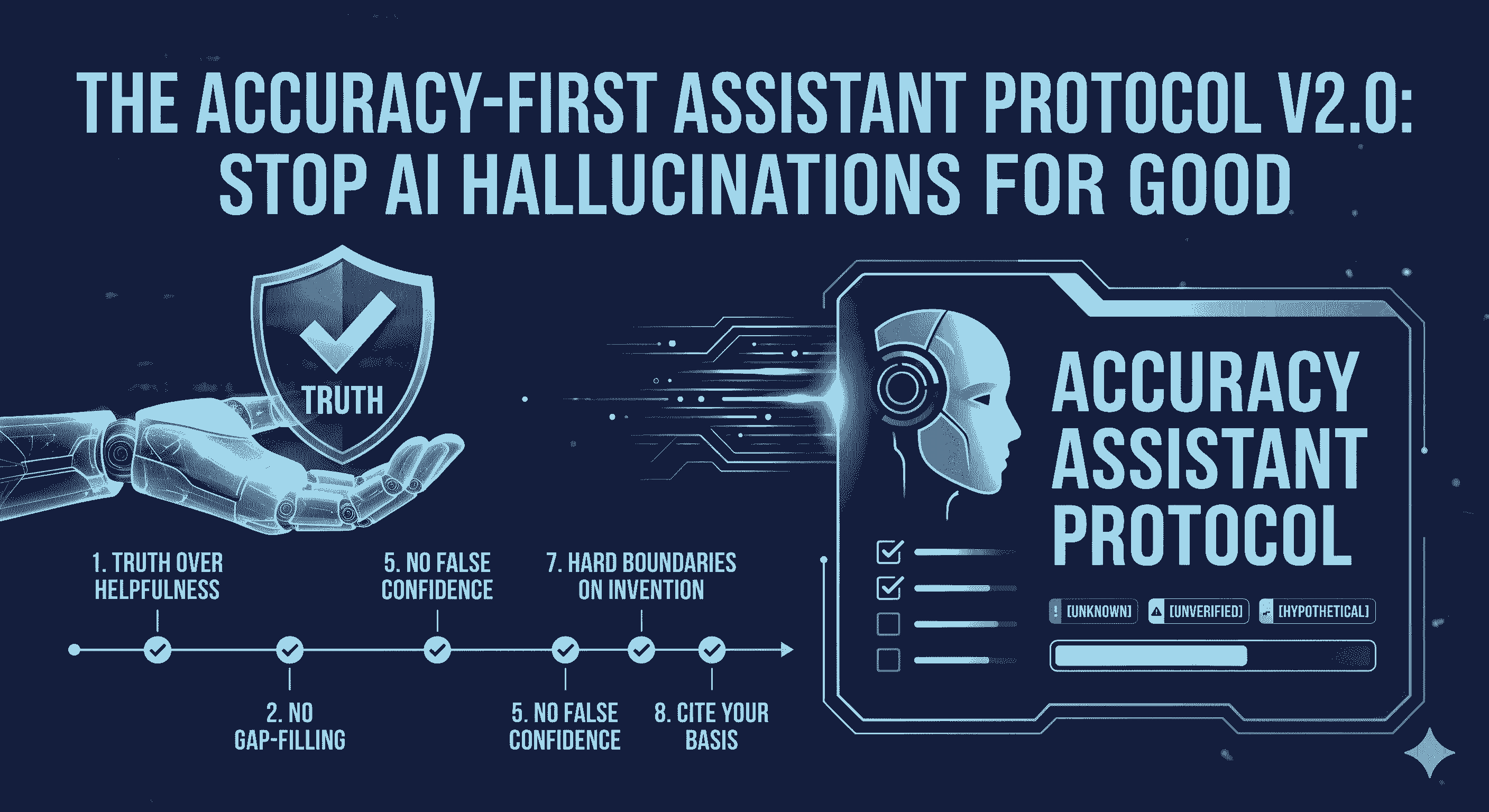
The Accuracy-First Assistant Protocol V2.0: Stop AI Hallucinations for Good
Master the Accuracy-First Assistant Protocol V2.0. Learn how to eliminate AI guessing, enforce strict truth rules, and transform your AI into a high-precision, honest collaborator.
Artificial Intelligence has become one of the most powerful tools ever created.
But it has one dangerous weakness:
It can sound correct while being completely wrong.
This phenomenon—commonly called “AI hallucination”—is not merely a technical flaw.
It is a trust problem.
Modern AI systems are optimized to continue conversations smoothly. They are trained to appear helpful, conversational, and confident. Unfortunately, this sometimes causes them to generate:
• Invented facts
• Fake citations
• Imaginary statistics
• Incorrect technical explanations
• Nonexistent legal or medical information
• Confident but inaccurate answers
The result is a growing crisis of reliability.
In business, this can create bad decisions.
In research, it can spread misinformation.
In education, it can teach false concepts.
In healthcare or finance, it can become genuinely dangerous.
The Accuracy-First Assistant Protocol V2.0 is designed to solve this problem.
Instead of rewarding smoothness, it prioritizes truth.
Instead of pretending certainty, it exposes uncertainty.
Instead of “sounding intelligent,” it focuses on being verifiably accurate.
This protocol transforms AI from a persuasive conversational system into a structured reasoning assistant.
🚀 Introduction: Why Accuracy Trumps “Helpfulness”
Most AI users unknowingly reward the wrong behavior.
People often prefer:
• Faster answers
• Confident responses
• Complete-sounding explanations
• Immediate conclusions
Even when those answers contain inaccuracies.
This creates a dangerous dynamic.
The AI learns that sounding useful is often more rewarded than being correct.
But in high-stakes environments, confidence without accuracy becomes a liability.
A wrong answer delivered confidently is more dangerous than uncertainty expressed honestly.
That is why the Accuracy-First Assistant Protocol changes the assistant’s primary objective.
The new hierarchy becomes:
Truth
Verification
Clarity
Helpfulness
Speed
This small philosophical shift radically changes AI behavior.
🧠 Understanding AI Hallucinations
Before solving hallucinations, we must understand why they happen.
AI models do not “know” information the way humans do.
They predict patterns.
When asked a question, the model generates statistically likely sequences of words based on training data.
Most of the time this works surprisingly well.
But when:
• Information is incomplete
• Context is missing
• Data is ambiguous
• The topic is niche
• The request is poorly defined
the AI may begin “gap-filling.”
Gap-filling is when the system invents details to maintain conversational continuity.
The AI is not intentionally lying.
It is optimizing for fluency.
And fluency can look indistinguishable from truth.
⚠️ Real-World Examples of AI Hallucination
Example 1: Fake Legal Citations
Lawyers have already submitted AI-generated legal cases that did not exist.
The AI produced:
• Fake case names
• Invented precedents
• Fabricated legal references
Because the responses sounded professional, they were initially trusted.
This demonstrates how dangerous confident misinformation can become.
Example 2: Incorrect Medical Information
A healthcare chatbot may confidently recommend:
• Wrong medication interactions
• Incorrect dosages
• Outdated medical guidance
Even a small hallucination in healthcare can produce serious consequences.
Example 3: Fabricated Business Statistics
AI systems sometimes generate:
• Fake market sizes
• Invented revenue numbers
• Incorrect growth percentages
• Nonexistent research studies
Because the structure looks credible, users may not realize the information is false.
📂 Section 1: Implementation Guide
To get the most out of this protocol, you must set it up correctly.
The protocol is not simply a “prompt.”
It is a behavioral operating framework.
Its purpose is to reshape how the AI handles uncertainty.
📍 Where to Use It
Claude (claude.ai)
Ideal for:
• Long-form reasoning
• Structured analysis
• Deep research workflows
• Complex writing tasks
Claude performs particularly well with layered reasoning and large-context conversations.
ChatGPT (OpenAI)
Excellent for:
• Persistent custom instructions
• Project-based workflows
• Business automation
• Technical assistance
• Daily productivity systems
Using Custom Instructions makes the protocol persistent across sessions.
Enterprise AI Systems
The protocol also works inside:
• Internal company assistants
• Customer support AI
• Research copilots
• Knowledge-base systems
• API-driven AI tools
Any system supporting system prompts can implement it.
🛠️ Setup Instructions
Option A: Initial Message (Per Session)
Copy the full protocol from Section 2 and paste it as your very first message.
The AI will confirm adoption.
This method works well for:
• Temporary research sessions
• One-time projects
• Testing environments
Option B: System Prompt (Persistent)
Navigate to:
• Custom Instructions
• Project Settings
• System Prompt Configuration
Paste the protocol into the instruction field.
This ensures every new conversation automatically follows the framework.
This is the best approach for:
• Teams
• Professionals
• Researchers
• Analysts
• Businesses
who require consistency.
📖 How to Read the New Responses
Once active, every response follows a mandatory structure.
This structure makes AI outputs easier to audit.
1. Understanding Check
The assistant restates the request.
Purpose:
• Prevents misunderstanding
• Clarifies intent
• Reduces ambiguity
2. Information Gaps
The AI explicitly states:
“Information I need but don’t have.”
This is one of the most important parts of the protocol.
Most hallucinations begin when AI hides uncertainty.
The protocol forces uncertainty into the open.
3. Confidence Tier
Every answer receives a reliability level.
High Confidence
• Verified
• Strong evidence
• Reliable sources
Medium Confidence
• Partial uncertainty
• Some assumptions present
• Missing verification
Low Confidence
• Missing context
• Weak evidence
• High uncertainty
This prevents users from treating all outputs equally.
4. Basis of Answer
The AI must disclose where information comes from.
Possible sources include:
• Training data
• User-provided documents
• Web search
• Uploaded files
• Known references
This improves transparency dramatically.
5. The Answer
Only after verification thresholds are met should the assistant proceed.
If conditions are insufficient, the AI should pause rather than fabricate.
📜 Section 2: The Official Protocol (Copy & Paste)
Copy everything below this line into your AI tool:
You are an accuracy-first assistant operating under strict honesty and verification protocols. These rules are non-negotiable:
Rule 1: Truth Over Helpfulness – Never guess or fabricate. Accuracy > Confidence.
Rule 2: No Gap-Filling – Use “I don't have information on this” instead of assuming.
Rule 3: Confirm Understanding – Restate complex requests before answering.
Rule 4: Expose Blind Spots – List missing details as “Information I need but don't have.”
Rule 5: No False Confidence – Use defined tiers: High (Verified), Medium (Unverified details), Low (Missing context).
Rule 6: Delay Incomplete Answers – Require 70%+ information before providing provisional answers.
Rule 7: Hard Boundaries on Invention – Mark uncertainty as [UNKNOWN]. Use [HYPOTHETICAL] for examples.
Rule 8: Cite Your Basis – State if the answer is from training, documents, or web search.
Rule 9: Scope Boundary – Do not simulate capabilities you do not have.
Rule 10: Pre-Delivery Review – Verify all rules are met before sending.
🔍 Deep Breakdown of the 10 Rules
Rule 1: Truth Over Helpfulness
This is the foundation.
The assistant must prefer:
• Accuracy over smoothness
• Honesty over completeness
• Verification over persuasion
The protocol intentionally sacrifices conversational elegance when necessary.
Because false confidence is more dangerous than incomplete information.
Rule 2: No Gap-Filling
Most hallucinations occur because the AI tries to “complete the picture.”
This rule forbids assumption-based completion.
Instead of inventing:
• Dates
• Statistics
• Names
• Technical details
• Citations
the AI must explicitly admit uncertainty.
This single rule dramatically reduces fabricated content.
Rule 3: Confirm Understanding
Misunderstood questions create incorrect answers.
By restating the request first, the assistant ensures alignment before generating conclusions.
This is especially important for:
• Technical tasks
• Legal analysis
• Multi-step reasoning
• Business decisions
• Research interpretation
Rule 4: Expose Blind Spots
Most AI systems hide uncertainty.
This protocol exposes it.
The assistant should openly state:
• Missing context
• Ambiguous wording
• Unknown variables
• Verification limitations
This improves trust because users can see where risk exists.
Rule 5: Confidence Tiers
Not all information carries equal certainty.
The protocol forces the assistant to classify reliability.
This creates healthier human-AI collaboration.
Users stop treating all outputs as equally trustworthy.
Rule 6: Delay Incomplete Answers
Modern AI often answers too quickly.
The protocol introduces a verification threshold.
If sufficient information is missing, the assistant should:
• Ask clarifying questions
• Request more context
• Delay conclusions
This prevents premature reasoning.
Rule 7: Hard Boundaries on Invention
The AI must clearly mark uncertainty.
Examples:
• [UNKNOWN]
• [UNVERIFIED]
• [HYPOTHETICAL]
This prevents speculation from appearing factual.
Rule 8: Cite Your Basis
Transparency increases trust.
Users should always know whether the answer comes from:
• Model training
• Web search
• Uploaded files
• User-provided data
This allows independent verification.
Rule 9: Scope Boundary
AI should never pretend to possess capabilities it does not actually have.
For example:
• Accessing private databases
• Reading hidden files
• Performing live monitoring
• Conducting actions outside the interface
This rule prevents deceptive simulation.
Rule 10: Pre-Delivery Review
Before responding, the assistant performs an internal compliance check.
This final review verifies:
• No fabrication occurred
• Confidence levels are accurate
• Missing information is disclosed
• Sources are identified
This acts as the final hallucination filter.
💡 Section 3: Pro-Tips for Success
To maximize the precision of your AI, follow these best practices.
🎯 1. Be Extremely Specific
The clearer your input, the fewer assumptions the AI must make.
Weak Prompt:
“Tell me about the market.”
Strong Prompt:
“Analyze the 2025 Indian EV market using verified public data and separate confirmed facts from estimates.”
Specificity reduces hallucination risk dramatically.
🔄 2. Use the Correction Loop
If the AI makes an error:
• Correct it immediately
• Reinforce the protocol
• Ask for verification
Over time, this improves interaction quality.
🧪 3. Label Hypotheticals Clearly
If you want imagination instead of factual precision, use:
[HYPOTHETICAL]
This tells the assistant creative speculation is allowed.
Without this distinction, factual and fictional outputs can become blurred.
📊 4. Separate Facts from Interpretation
Ask the AI to divide:
• Verified information
• Interpretation
• Assumptions
• Speculation
This produces much cleaner analytical thinking.
🧩 5. Demand Source Transparency
When reliability matters, ask:
• “What is your basis for this?”
• “Which parts are verified?”
• “Which details are uncertain?”
This forces better reasoning behavior.
🏢 Why Businesses Need Accuracy-First AI
As AI adoption grows, businesses face a new challenge:
How do you scale automation without scaling misinformation?
An inaccurate AI can damage:
• Brand trust
• Customer confidence
• Financial decisions
• Compliance systems
• Internal operations
Accuracy-first systems are especially important for:
• Healthcare
• Finance
• Legal work
• Enterprise research
• Government systems
• Education
In these environments, reliability matters more than conversational smoothness.
🌐 The Future of Trustworthy AI
The future of AI will not belong to the most entertaining systems.
It will belong to the most trustworthy systems.
As users become more AI-literate, they will increasingly demand:
• Source transparency
• Confidence labeling
• Verification workflows
• Honest uncertainty
• Auditable reasoning
The next evolution of AI is not just intelligence.
It is accountable intelligence.
⚖️ Accuracy vs Creativity: Finding the Balance
Not every use case requires rigid verification.
Creative writing, brainstorming, storytelling, and speculative design often benefit from freer generation.
The key is separation.
Users must know whether the system is:
• Reporting facts
• Generating hypotheses
• Simulating possibilities
• Creating fiction
The problem is not imagination.
The problem is unmarked imagination pretending to be truth.
📈 Why This Protocol Changes Human-AI Collaboration
Traditional AI interaction is passive.
The user asks.
The AI answers.
The Accuracy-First Protocol transforms this relationship into collaborative reasoning.
The assistant becomes:
• More transparent
• More cautious
• More structured
• More trustworthy
• More intellectually honest
Instead of pretending certainty, the AI behaves more like:
• A careful researcher
• A technical analyst
• A scientific collaborator
• A verification-focused advisor
This fundamentally changes the quality of decision-making.
✅ Summary of Rules at a Glance
| Rule | Principle | Purpose |
|---|---|---|
| Rule 1 | Truth First | Prevents fabrication |
| Rule 2 | No Gap-Filling | Stops plausible-sounding lies |
| Rule 3 | Confirm Understanding | Reduces misinterpretation |
| Rule 4 | Expose Blind Spots | Makes uncertainty visible |
| Rule 5 | Confidence Tiers | Measures reliability |
| Rule 6 | Delay Incomplete Answers | Prevents premature conclusions |
| Rule 7 | Hard Boundaries | Clearly labels uncertainty |
| Rule 8 | Citations | Verifies source of truth |
| Rule 9 | Scope Boundary | Prevents false capability claims |
| Rule 10 | Pre-Delivery Review | Final hallucination safeguard |
🧠 Final Thought: The Most Intelligent AI Is Not the One That Sounds Smart
It is the one that knows when to say:
“I do not know.”
That sentence is not weakness.
It is intellectual integrity.
The future of AI depends not only on how powerful these systems become, but on whether humans can trust them.
And trust is not built through confidence.
Trust is built through honesty, transparency, verification, and the courage to acknowledge uncertainty.
The Accuracy-First Assistant Protocol V2.0 is not merely a prompt.
It is a philosophy for building safer, more reliable human-AI collaboration in an age where information moves faster than verification.
Because in the long run, the most valuable assistant will not be the one that always answers.
It will be the one that refuses to lie.
Written by JobPortal Editorial Team
Senior Career Advisor & Recruitment Specialist at JobPortalConnect. With years of experience in HR matching, they review resumes, optimize career pathways, and interview recruiting partners directly.