



Mobile Accessibility (a11y) & Localization (i18n): 15 Core Questions
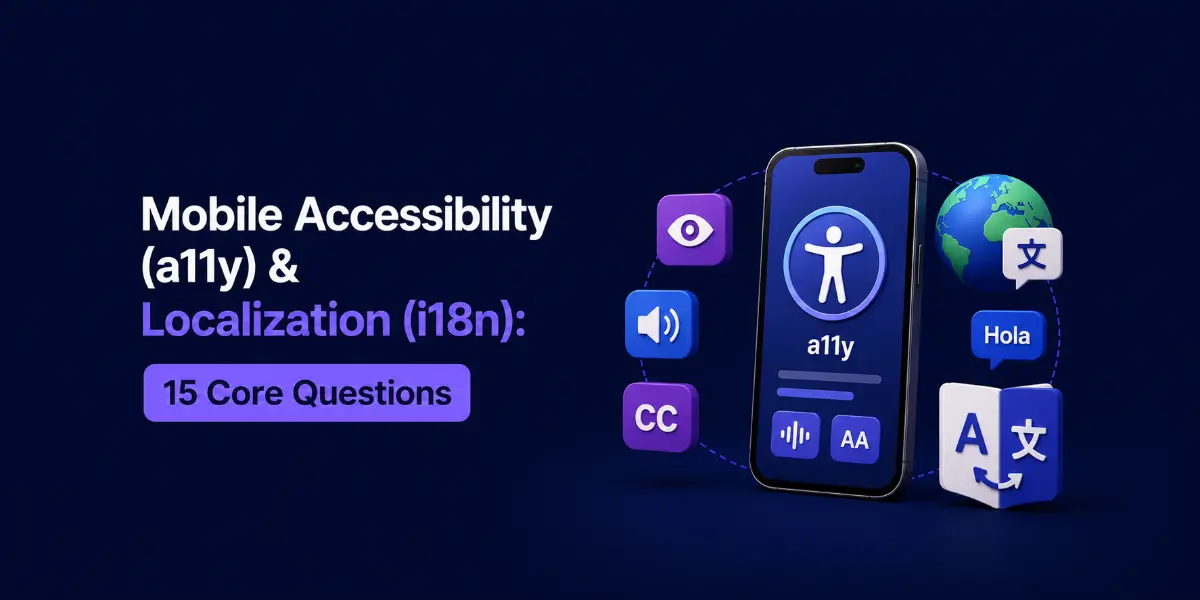
Building inclusive mobile applications requires addressing accessibility standards (ADA/European Accessibility Act) and internationalization. Senior mobile developers must master custom screen reader semantic descriptions, dynamic font layout adaptations, and Right-to-Left (RTL) localization layouts. This article explores 15 core questions.
Questions Quick Links
- Q1. VoiceOver vs. TalkBack screen readers
- Q2. Custom Semantic Labels configuration
- Q3. Dynamic Type & Font Scaling layouts
- Q4. Right-to-Left (RTL) alignments
- Q5. WCAG Color Contrast compliance
- Q6. Accessibility Traits & Roles
- Q7. Custom Screen Reader Focus loops
- Q8. Semantic Grouping of sub-elements
- Q9. Automated Accessibility testing tools
- Q10. Haptic Feedbacks for assistive loops
- Q11. Voice Control navigation setups
- Q12. Pluralization & dynamic translations
- Q13. Non-text elements descriptions
- Q14. Handling Reduce Motion flags
- Q15. System-wide dark mode styling updates
Q1. Compare VoiceOver (iOS) and TalkBack (Android) screen readers.
Answer:
- VoiceOver (iOS): Parses the application's UIKit/SwiftUI accessibility tree, reading elements sequentially using default left-to-right swipe patterns.
- TalkBack (Android): Queries the layout's
AccessibilityNodeInfotree, traversing visible components in sequence. Both systems use text labels, element traits, and states to announce components.
Q2. How do you configure custom semantic descriptions (Accessibility Labels)?
Answer:
Assign descriptive text describing the element's *purpose* instead of its layout shape.
- SwiftUI:
.accessibilityLabel("Close panel") - Android XML:
android:contentDescription="Close panel" - Flutter:
Semantics(label: "Close panel", child: ...)
Q3. How do you support Dynamic Type (font scaling) without breaking layouts?
Answer:
Avoid hardcoding height values on layout containers. Use scalable font metrics (like SwiftUI `@ScaledMetric` or relative Compose `sp` values). Enforce scrollable view layouts (`ScrollView`) to prevent text clips when users scale font configurations.
Q4. How do you manage Right-to-Left (RTL) localizations (e.g. Arabic, Hebrew)?
Answer:
Avoid hardcoding "left" and "right" alignments. Use **leading** and **trailing** constraints on iOS and Android. In Flutter, use `Directionality` widgets which automatically mirror row alignments when the locale updates.
Q5. What is the WCAG contrast standard? How do you verify colors?
Answer:
The Web Content Accessibility Guidelines (WCAG 2.1) require a contrast ratio of at least **4.5:1** for normal text and **3:1** for large text to satisfy Level AA standards. Enforce this by testing layouts with contrast checker tools during design phases.
Q6. What are Accessibility Traits (iOS) and Roles (Android)?
Answer:
They specify the structural *behavior* of elements.
- iOS Traits: Declaring a view has trait `.button` makes VoiceOver append "button" to the announcement, indicating it is clickable.
- Android Roles: Annotating custom layout nodes with clickable roles tells TalkBack to announce them as interactive components.
Q7. How do you implement custom screen reader focus loops?
Answer:
By default, screen readers read elements top-down, left-to-right. To modify this (e.g. reading columns first), declare custom focus order lists (like SwiftUI's `.accessibilitySortPriority` or Flutter's `SemanticsSortKey`).
Q8. What is Semantic Grouping? When is it used?
Answer:
If a layout card contains an image, a username, and a timestamp, the screen reader would normally require three taps. By wrapping the card in a semantic group (using SwiftUI's `.accessibilityElement(children: .combine)`), the screen reader reads all details in a single announcement.
Q9. How do you test accessibility programmatically and manually?
Answer:
- Manual: Use the **Accessibility Inspector** on Xcode (running on an iOS simulator) or Google's **Accessibility Scanner** app on Android to identify missing tags.
- Programmatic: Write UI unit tests to verify that critical buttons have valid, non-empty accessibility identifiers.
Q10. How do you support Haptic Feedback (taptic engine) as an assistive fallback?
Answer:
Trigger physical vibrations to confirm actions (e.g., successful barcode scan) for users who cannot see visual changes. Use iOS `UINotificationFeedbackGenerator` or Android `Vibrator` services.
Q11. How do you design applications for Voice Control / Voice Access?
Answer:
Ensure all actionable elements (buttons, links) have matching visible text labels and accessibility names (e.g. if a button displays "Sign in", its accessibility label should be "Sign in", not "Submit").
Q12. How do you manage translations for plural dynamic strings (e.g. "1 message" vs "3 messages")?
Answer:
Never hardcode plural logic in Swift/Kotlin. Use **plural resource files**: iOS `Localizable.stringsdict` and Android `strings.xml` with ``. The system automatically selects the correct translation pattern based on the count parameter.
Q13. How should you describe decorative graphics to screen readers?
Answer:
Decorative elements (like background gradients or icons that add no informational value) should be explicitly ignored (e.g. setting `accessibilityHidden(true)` on iOS or `android:importantForAccessibility="no"` on Android) to prevent cluttering navigation.
Q14. How should your application handle "Reduce Motion" system preferences?
Answer:
Query system motion status (`UIAccessibility.isReduceMotionEnabled` on iOS). When enabled, disable parallax animations and replace scaling screen transitions with simple fade transitions.
Q15. How do you support system-wide dark mode styling?
Answer:
Define your color assets using dynamic color catalogs (`Assets.xcassets` on iOS, `colors.xml` with a `values-night` directory on Android) that specify separate HEX/RGB tokens for light and dark modes, allowing the OS to swap themes automatically.
Written by Accessibility & Localization Lead
Senior Career Advisor & Recruitment Specialist at JobPortalConnect. With years of experience in HR matching, they review resumes, optimize career pathways, and interview recruiting partners directly.