





Pharmaceutical QC Written Exam Question Bank – Part 3: Viva Q&A & Essay Outlines
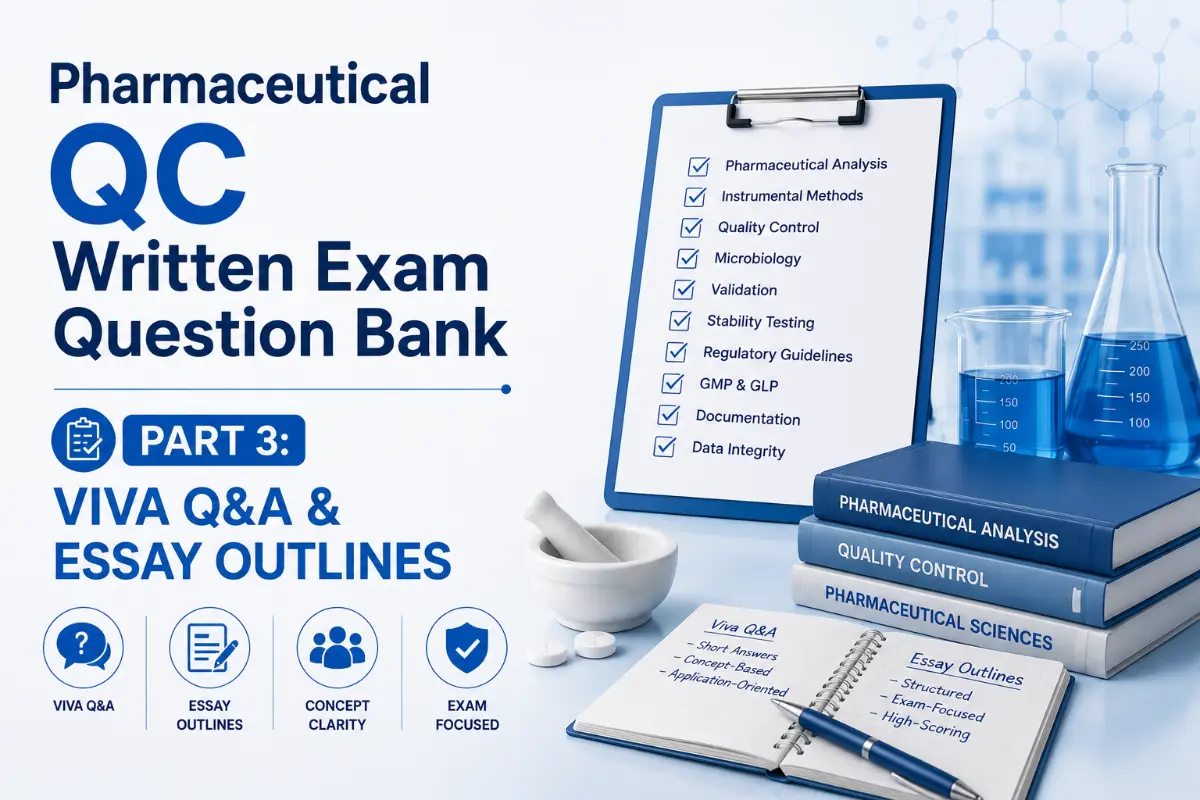
Welcome to Part 3 of the Ultimate Pharmaceutical Quality Control written exam preparation guide. In this final installment, we cover frequently asked viva/interview questions (including materials management, standards, and impurities analysis) and provide comprehensive, highly structured free-hand writing outlines for the essay-writing section—covering both general environmental and pharmaceutical compliance topics.
Part 3 Sections
- 🔬 Part 3.1: Viva + Written Technical Q&A (Q171 - Q180)
- 🌍 Part 3.2: General & Environmental Essay Outlines (Q181 - Q190)
- 💊 Part 3.3: Pharmaceutical Compliance Essay Outlines (Q191 - Q200)
🔬 Part 3.1: Frequently Asked Viva + Written Questions
171. What is FEFO and why is it followed?
Answer: **FEFO** stands for **First Expired, First Out**. It is a inventory management protocol where materials with the earliest expiration dates are used or distributed first, regardless of when they were received. It is followed to minimize material waste, prevent product expiry on shelves, and ensure patients receive drugs with maximum shelf life.
172. What is the difference between FEFO and FIFO?
Answer: **FIFO** (First In, First Out) uses or dispatches materials based on their date of receipt (the oldest stock is used first). **FEFO** (First Expired, First Out) uses or dispatches materials based on their expiration date (the soonest to expire is used first). FEFO is preferred in pharmaceuticals to prevent inventory from expiring.
173. What is a working standard?
Answer: A working standard (or secondary standard) is a highly purified compound prepared, standardized, and verified against a primary reference standard for routine daily testing in the QC lab.
174. What is a reference standard?
Answer: A reference standard is a highly characterized, authenticated chemical substance of high purity sourced from official pharmacopoeias (like USP, BP, or EP) used to calibrate instruments and qualify working standards.
175. What is a control sample?
Answer: A control sample is a verified sample of known composition and concentration run alongside unknown samples during an analytical batch to confirm that the assay testing system is operating correctly.
176. What is a retain sample?
Answer: A retain sample (or reserve sample) is a representative quantity of starting materials, packaging materials, or finished products kept in designated storage under label conditions for a specified period (typically 1-2 years past expiry) to enable testing in the event of customer complaints, recalls, or investigations.
177. What is an impurity profile?
Answer: An impurity profile is a comprehensive description of the identified and unidentified organic and inorganic impurities, degradation products, and residual solvents present in a drug substance or product, along with their threshold limits and origins.
178. What is a related substances test?
Answer: A chromatography test (usually HPLC) performed to detect and quantify organic impurities, manufacturing by-products, and degradation products present in a drug substance or drug formulation.
179. What is residual solvent testing?
Answer: An analytical test (typically performed using Gas Chromatography Headspace) to determine the concentration of volatile organic solvents (like ethanol, acetone, or hexane) remaining in the drug substance or product after manufacturing, verifying they are below safety thresholds set by ICH Q3C.
180. What is forced degradation study?
Answer: Also known as stress testing, it is the deliberate exposure of drug substances or products to extreme conditions (acid, base, oxidation, high temperature, UV/photolytic stress) to identify degradation pathways, structure of degradation products, and demonstrate the stability-indicating nature of the analytical method.
🌍 Part 3.2: General & Environmental Essay Outlines
181. Traffic congestion in Dhaka city: causes and solutions.
Outline:
- Causes: Rapid urbanization, narrow roads, high density of private vehicles, lack of centralized traffic signal automation, presence of slow-moving rickshaws alongside motorized transport, and illegal roadside parking.
- Solutions: Expansion of mass rapid transit (Metro Rail expansion), enforcing strict parking laws, introducing dedicated lanes for buses, removing illegal street occupations, and deploying automated traffic signaling systems.
182. Waterlogging problem in Bangladesh during rainy season.
Outline:
- Causes: Poorly planned drainage networks, accumulation of plastic waste clogging drains, filling up of natural water retention bodies/lakes for real estate, and riverbed siltation.
- Solutions: Regular cleaning and dredging of canals, ban on single-use plastics, preservation of low-lying flood-plains, and installing high-capacity municipal water pumping stations.
183. Air pollution: causes, effects, and preventive measures.
Outline:
- Causes: Brick kiln emissions, industrial smoke, vehicle exhaust (especially diesel engines), construction dust, and open waste burning.
- Effects: Chronic respiratory diseases, cardiovascular disorders, smog reducing visibility, and acid rain.
- Preventive Measures: Transitioning to clean green brick kiln technology, regular emission testing for vehicles, dust control spraying at construction sites, and planting urban trees.
184. Noise pollution and its impact on health.
Outline:
- Causes: Indiscriminate honking of hydraulic horns, brick-breaking machinery, industrial operations in residential areas, and loud public speakers.
- Impact: Hearing impairment, sleep disturbance, high blood pressure, cognitive impairment in children, and chronic stress.
- Solutions: Strict laws banning hydraulic horns, designated "silent zones" near hospitals/schools, and sound barrier installation.
185. Waste management problems and solutions.
Outline:
- Problems: Open dumping sites, low recycling rates, mixing of medical/industrial hazardous waste with municipal household waste, and plastic accumulation.
- Solutions: Implementation of household source segregation (organic vs recyclable), establishing municipal waste-to-energy plants, and strict enforcement of Extended Producer Responsibility (EPR) on packaging.
186. Unemployment in Bangladesh.
Outline:
- Causes: Mismatch between university curricula and industrial requirements (lack of technical skills), slow job growth in formal sectors, and low rates of entrepreneurship funding.
- Solutions: Restructuring education to emphasize vocational/technical skills (e.g. IT, pharmaceutical chemistry, electrical engineering), encouraging startups through seed funding, and establishing regional industrial export zones.
187. Climate change and its impact on Bangladesh.
Outline:
- Impact: Bangladesh is one of the most vulnerable nations. Rising sea levels lead to coastal salinity, destroying agricultural land in Southern regions, causing regular cyclones, river bank erosion, and creating millions of climate refugees migrating to Dhaka.
- Adaptation/Mitigation: Constructing cyclone shelters, planting mangrove barriers (Sunderbans protection), researching saline-tolerant rice varieties, and accessing international green climate funds.
188. Global warming: causes, effects, and prevention.
Outline:
- Causes: Burning fossil fuels, deforestation, greenhouse gas emissions ($CO_2, CH_4$), and agricultural operations.
- Effects: Melting polar ice caps, extreme weather patterns, and shifting agricultural seasons.
- Prevention: Accelerating wind and solar energy capacity, reforestation programs, and global treaties to limit temperature rises.
189. River pollution in Bangladesh.
Outline:
- Causes: Untreated industrial effluent dumping (tanneries, textile mills), chemical runoff from agricultural fields, and household plastic waste dump.
- Solutions: Installing mandatory Effluent Treatment Plants (ETP) at all factories, moving heavy industries away from major river banks, and strict penalties for environmental compliance violations.
190. Safe drinking water crisis and possible solutions.
Outline:
- Causes: Natural arsenic contamination in tube-wells, groundwater table depletion due to irrigation, industrial chemical leaching, and saline intrusion in coastal aquifers.
- Solutions: Implementing rainwater harvesting systems, installing municipal reverse osmosis purification plants, and monitoring aquifer safety regularly.
💊 Part 3.3: Pharmaceutical Compliance Essay Outlines
191. Importance of GMP in the pharmaceutical industry.
Outline:
- Core Concept: Good Manufacturing Practice (GMP) is a quality system that ensures products are consistently produced and controlled according to quality standards. It covers all aspects of production from starting materials, premises, and equipment to training and personal hygiene.
- Importance: Eliminates critical risks inherent in drug production (like cross-contamination, false labeling, incorrect dosage) which cannot be fully detected by final product testing alone, ensuring patient safety.
192. Role of Quality Control in pharmaceutical manufacturing.
Outline:
- Scope: Quality Control (QC) is concerned with sampling, specifications, and testing. It ensures that the necessary and relevant tests are actually carried out, and that materials are not released for use, nor products released for sale or supply, until their quality has been judged to be satisfactory.
- Core Duties: Material testing, environment monitoring, stability analysis, and instrumentation calibration.
193. How to reduce laboratory errors in QC.
Outline:
- Strategies: Implementing strict double-check verification steps, regular calibration of balances and pipettes, ensuring all analysts undergo thorough hands-on validation training before performing live testing, enforcing strict SOP compliance, and utilizing automated electronic systems (LIMS) to reduce human calculation errors.
194. Importance of documentation in pharmaceutical industries.
Outline:
- Rationale: In a GMP environment, documentation is key to traceability. It defines the quality system and provides clear, auditable evidence of compliance. It follows the fundamental rule: "If it is not documented, it did not happen." Documentation prevents errors caused by oral communication and facilitates batch history tracing during investigations.
195. Importance of training in pharmaceutical industries.
Outline:
- Rationale: The quality of operations depends heavily on the personnel executing them. Regular training ensures that all operators and analysts fully understand GMP rules, active SOPs, safety hazards, and specific machinery controls, reducing deviations and batch failures.
196. Laboratory safety practices in QC departments.
Outline:
- Practices: Wearing appropriate personal protective equipment (PPE), handling hazardous solvents inside fume hoods, keeping safety showers and eye-wash stations clear, labeling all reagents with prep/expiry dates, using safety carriers for transport of glass bottles, and maintaining Material Safety Data Sheets (MSDS) accessibility.
197. Common HPLC problems and troubleshooting methods.
Outline:
- Pressure fluctuations: Caused by air bubbles in the pump head (solution: purge/prime pump) or leakages.
- Baseline drift/noise: Caused by dirty detector flow cell (clean cell) or mobile phase contamination (prepare fresh).
- Peak splitting/tailing: Caused by frit contamination or column voiding (replace/reverse column).
198. Nitrosamine impurities in pharmaceuticals.
Outline:
- Problem: Nitrosamines (like NDMA) are genotoxic compounds classified as probable human carcinogens. They can form during chemical synthesis under acidic conditions in the presence of secondary/tertiary amines and nitrites.
- Control: Involves conducting risk assessments, testing materials using high-sensitivity LC-MS/MS methods, and reformulating to avoid raw materials containing amine residues.
199. Data Integrity (ALCOA+) in pharmaceutical industries.
Outline:
- Concept: Data integrity ensures that all records represent a complete, truthful, and unaltered history of the pharmaceutical process.
- Implementation: Enforcing **ALCOA+** principles by restricting administrative user controls on computers, implementing secure electronic audit trails, preventing the use of draft printouts or scrap paper, and archiving data securely.
200. How can pharmaceutical companies ensure product quality?
Outline:
- Strategy: By adopting a Quality-by-Design (QbD) approach in drug development, building a robust and compliant Quality Management System (QMS), qualifying suppliers strictly, validating processes, training employees, and maintaining a culture of quality where data integrity and patient safety are prioritized at every level of the organization.
Written by Lead QC Trainer & Senior Analyst
Senior Career Advisor & Recruitment Specialist at JobPortalConnect. With years of experience in HR matching, they review resumes, optimize career pathways, and interview recruiting partners directly.