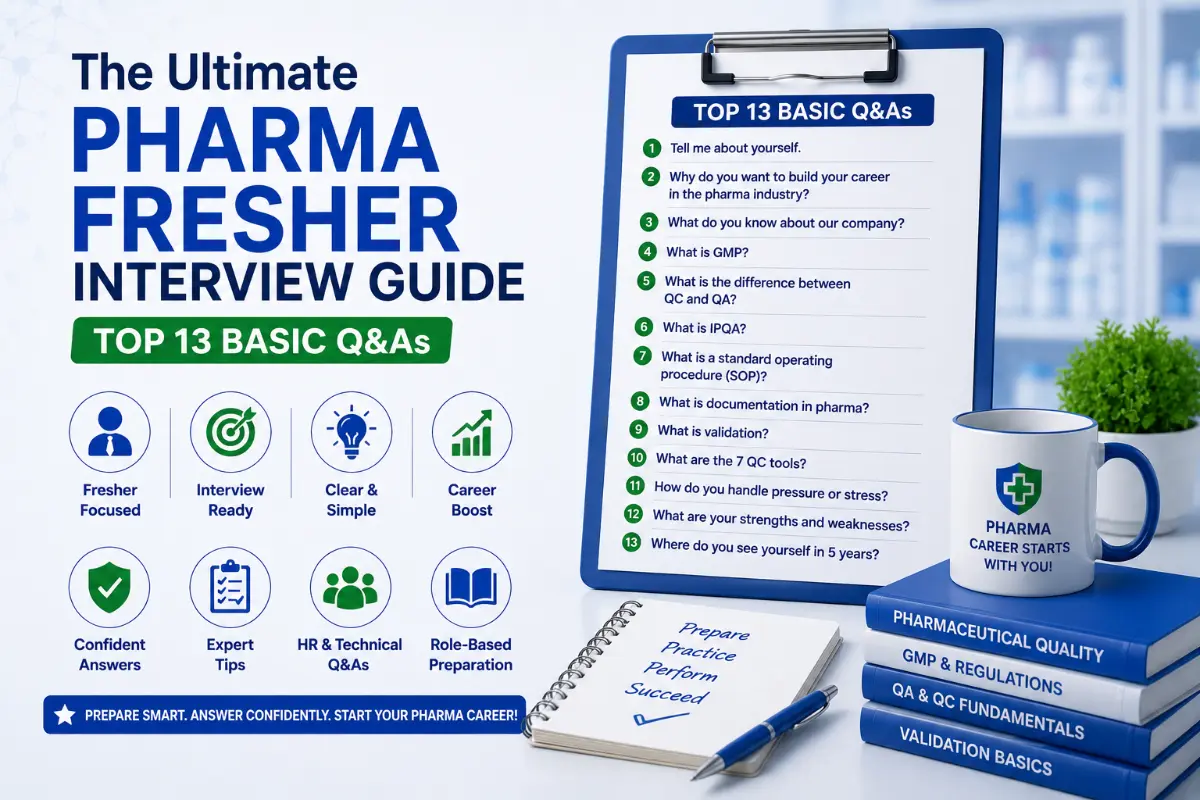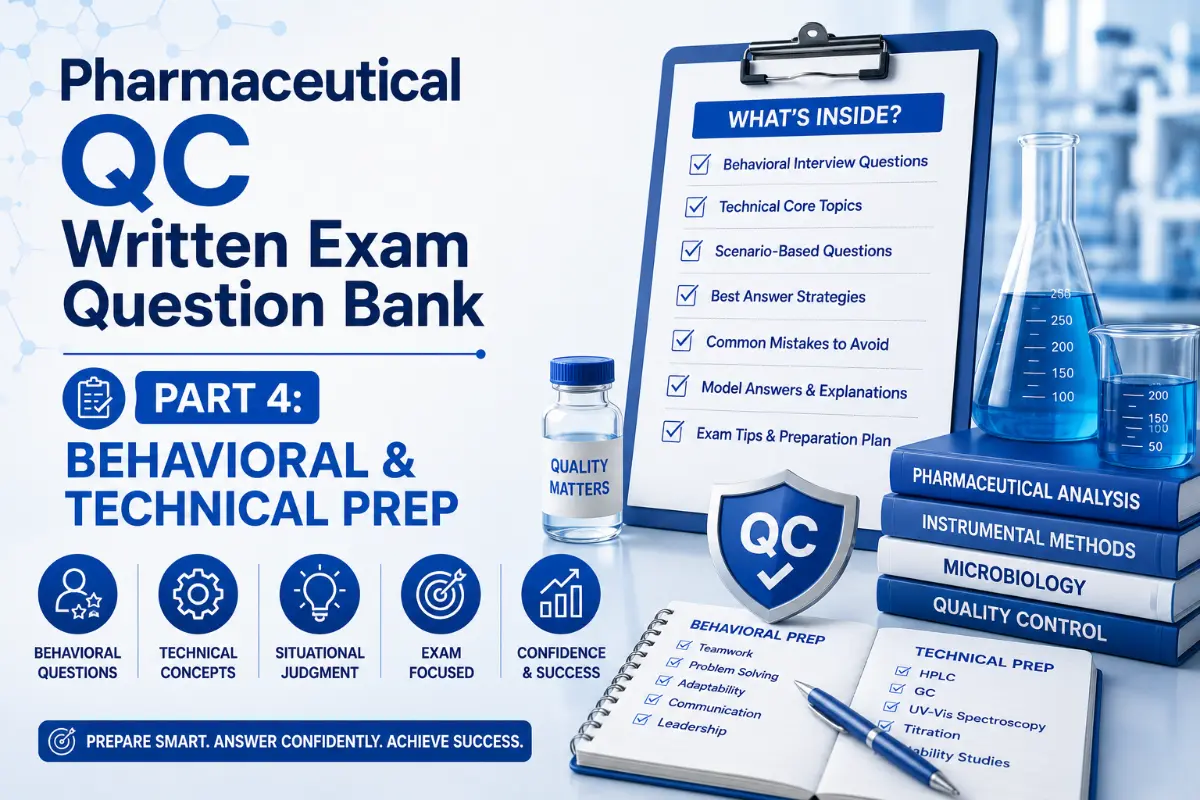






The Ultimate Pharma Fresher Interview Guide – Part 2: Technical & HR Basics
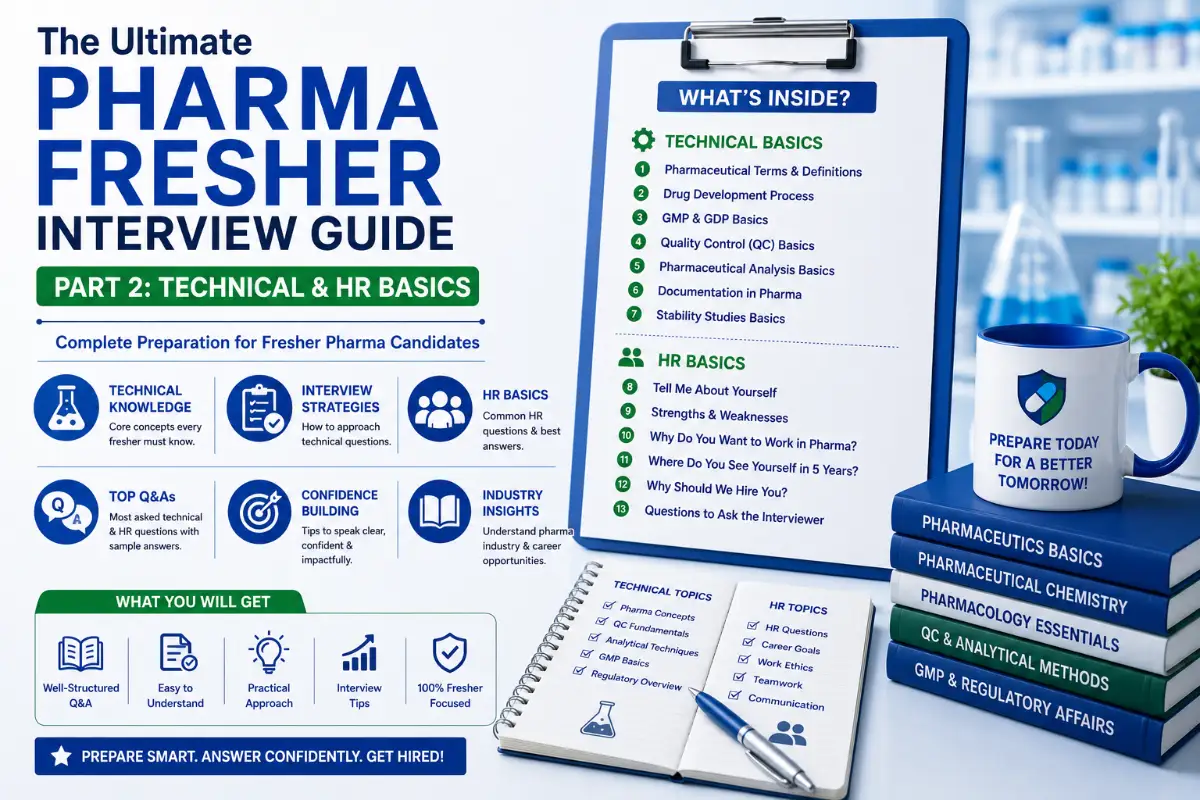
Welcome to Part 2 of the Ultimate Pharmaceutical Fresher Interview Guide. While Part 1 covered basic science and pharmacokinetics, hiring managers also assess your understanding of quality control compliance systems and how your personal career goals align with industrial regulatory culture. Below are 12 essential technical and HR questions complete with professional answers.
Part 2 Sections
- 🔬 Compliance & Quality Technical Basics (Q14 - Q19)
- 💼 Personal & Behavioral HR Questions (Q20 - Q23)
- 📋 Documentation & Corporate Structure (Q24 - Q25)
- 💡 Essential Preparation Checklist
🔬 Compliance & Quality Technical Basics
14. What is a deviation?
Answer: A deviation is any unplanned or unexpected departure from an approved Standard Operating Procedure (SOP), validation protocol, master batch record, or established manufacturing specification during operations.
15. What is validation?
Answer: Validation is the documented process of providing scientific evidence that a specific process, testing method, or system will consistently and reproducibly yield results meeting predefined acceptance criteria.
16. What is calibration?
Answer: Calibration is the comparison of an instrument's measurements against a known, traceable reference standard of verified accuracy to detect and document any measurement deviations.
17. What is contamination?
Answer: Contamination is the unwanted introduction of chemical, physical, or microbiological impurities, foreign substances, or materials into starting ingredients, intermediates, or finished products during manufacturing, sampling, or packaging.
18. What is the difference between sterile and non-sterile products?
Answer:
- Sterile Products: Must be completely free from all living microorganisms. Examples include injectable infusions, vaccines, and ophthalmic eye drops. They are processed under strict Class A/B cleanroom conditions.
- Non-Sterile Products: Are allowed to contain controlled, minor levels of non-pathogenic microorganisms within strict regulatory limits. Examples include tablets, hard capsules, and topical creams.
19. What is HPLC?
Answer: HPLC stands for High-Performance Liquid Chromatography. It is a powerful analytical laboratory separation technique that uses a liquid mobile phase under high pressure to drive a sample mixture through a packed stationary phase column, allowing the separation, identification, and quantitative measurement of individual components.
💼 Personal & Behavioral HR Questions
20. What are your strengths?
Answer: "My core strengths include a willingness to learn new technical skills, strong attention to detail which is critical for GDP compliance, a positive attitude under stress, and the ability to collaborate effectively in team-oriented laboratory environments."
21. What is your weakness?
Answer: "As a recent graduate, my main limitation is a lack of real-world industrial experience in a pharmaceutical plant. However, I am actively bridging this gap by studying GMP guidelines, learning SOP layouts, and I adapt quickly to hands-on instrumentation training."
22. Why should we hire you?
Answer: "You should hire me because I offer a strong, fresh academic understanding of pharmaceutical analysis and a disciplined mindset geared towards quality compliance. I am highly motivated to learn your specific plant procedures, adapt quickly to shifts, and contribute to maintaining your quality standards."
23. Where do you see yourself in 5 years?
Answer: "In five years, I see myself growing into a skilled, senior pharmaceutical quality professional with deep technical expertise in operating analytical instruments like HPLC/GC and managing regulatory audits, taking on greater leadership responsibilities within the team."
📋 Documentation & Corporate Structure
24. What is ALCOA+ in pharma documentation?
Answer: ALCOA+ represents the standard guidelines for ensuring data integrity:
- Attributable (Who wrote it)
- Legible (Readable)
- Contemporaneous (Recorded in real-time)
- Original (First execution data)
- Accurate (Truthful values)
- + Complete, Consistent, Enduring, and Available.
25. What are the main departments in a pharmaceutical company?
Answer: A standard pharmaceutical company is structured into several collaborative departments:
- Production/Manufacturing: Formulates and packages the drugs.
- Quality Assurance (QA): Standardizes and monitors processes and compliance.
- Quality Control (QC): Tests and analyzes raw materials and batches.
- Research & Development (R&D): Invents and designs new formulations.
- Regulatory Affairs (RA): Handles registrations and communications with health authorities.
- Warehouse/Logistics: Stores raw materials and coordinates distribution.
- Production Planning & Inventory Control (PPIC): Manages material inventory and coordinates manufacturing schedules.
💡 Essential Preparation Checklist
Before stepping into your interview, ensure you have revised these key concepts:
- GMP & GLP Rules
- SOP layouts
- Differences in QA vs QC
- Dosage forms classification
- ALCOA+ principles
- Basic Chromatography definitions
Written by Senior Academic Counselor & HR Partner
Senior Career Advisor & Recruitment Specialist at JobPortalConnect. With years of experience in HR matching, they review resumes, optimize career pathways, and interview recruiting partners directly.