






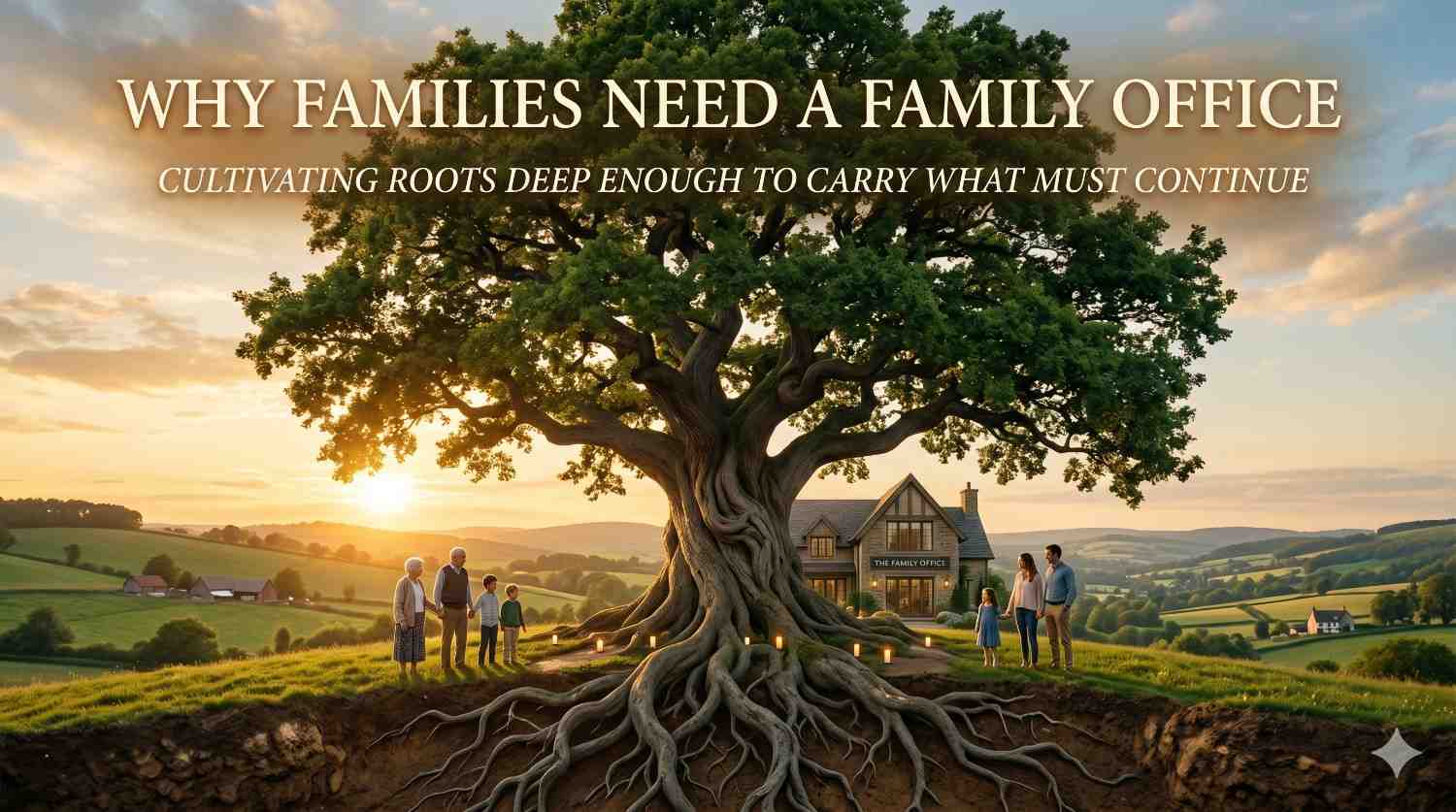
Why Families Need a Family Office
A Family Office is more than a financial entity; it is the conscious cultivation of roots deep enough to carry what must continue.
For many people, the phrase “Family Office” immediately evokes images of billionaire dynasties, private investment firms, luxury estates, and generational wealth beyond imagination.
But this understanding is incomplete.
The true essence of a Family Office begins long before wealth becomes glamorous.
It begins at the exact moment a family realizes that success is no longer only personal.
It has become generational.
A Family Office is not fundamentally about money.
It is about continuity.
It is about ensuring that what has been built through decades of sacrifice, discipline, and vision does not disappear within a single generation.
At its deepest level, a Family Office is the architecture of long-term stewardship.
It exists to answer one profound question:
What must continue when the original builder is gone?
🌳 The Question Beneath the Question
Most people ask:
“Why do families need a Family Office?”
But the deeper and more important question is:
“What survives beyond the founder?”
The real issue is rarely wealth alone.
It is continuity.
It is stewardship.
It is the challenge of whether:
• The business survives
• The values remain intact
• The family stays united
• The next generation becomes capable
• The legacy avoids fragmentation
Many families spend decades building wealth.
Very few spend equal energy preparing their children to carry it wisely.
That imbalance becomes dangerous.
Because wealth without structure often creates confusion instead of security.
“A Family Office is not born when wealth becomes glamorous. It begins when responsibility becomes transgenerational.”
🏛️ Beyond the Modern Misconception
One of the biggest misconceptions is that Family Offices are only for ultra-high-net-worth individuals.
The media often portrays them as private organizations reserved for billionaires with:
• Private jets
• Global investments
• Luxury portfolios
• Multi-country tax structures
• Institutional wealth teams
While large Family Offices certainly exist, the Family Office mindset is not exclusive to billionaires.
A Family Office begins whenever a family decides:
“What we have built must outlive us.”
This shift can happen:
• In a first-generation business family
• In a growing entrepreneurial household
• In a successful professional family
• In a family with valuable land or assets
• In a founder-led enterprise
The need is not defined purely by wealth.
It is defined by complexity, continuity, and responsibility.
🌱 The Difference Between Wealth and Stewardship
Most people focus on accumulating wealth.
Far fewer understand stewardship.
Wealth asks:
“How much can we build?”
Stewardship asks:
“How long can it survive?”
This distinction changes everything.
Because history repeatedly shows the same pattern:
• First generation builds
• Second generation expands
• Third generation consumes
• Fourth generation struggles to remember why it existed
Without structure, memory fades.
And when memory disappears, discipline usually disappears with it.
A Family Office exists to preserve not only assets, but also orientation.
🌳 The Tree Must Outlive the Planter
In business and success, society celebrates the visible tree:
• Revenue
• Reputation
• Assets
• Influence
• Lifestyle
• Recognition
But history teaches a quieter lesson.
The tree that survives for decades is not simply the one that grew highest.
It is the one that learned how to grow deep.
Families collapse not only because of financial problems.
They collapse because:
• Governance was weak
• Communication disappeared
• Succession was unclear
• Entitlement replaced responsibility
• Values were never transferred
The visible structure can appear powerful while the invisible structure quietly weakens.
A Family Office strengthens the invisible architecture.
🧩 The Invisible Roots of Continuity
Continuity is carried through systems most people never see.
These are the roots beneath the visible tree.
📜 Governance
Governance determines how decisions continue when the founder is no longer present.
Many founder-led families unknowingly centralize everything around one individual.
The founder becomes:
• The decision-maker
• The relationship manager
• The strategist
• The financial authority
• The emotional stabilizer
This works temporarily.
But eventually the family becomes dangerously dependent on a single person.
A Family Office introduces structure:
• Family constitutions
• Decision frameworks
• Advisory boards
• Voting systems
• Conflict resolution mechanisms
This allows continuity beyond personality.
🎓 Education
One of the greatest risks to generational wealth is unprepared inheritance.
Children may inherit:
• Wealth
• Equity
• Assets
• Ownership
without inheriting:
• Financial literacy
• Emotional maturity
• Responsibility
• Discipline
• Stewardship mindset
A Family Office helps educate the next generation.
This includes:
• Investment education
• Business understanding
• Leadership development
• Philanthropic responsibility
• Long-term thinking
Real Example:
A successful business owner may spend 30 years building a manufacturing company.
But if the next generation only understands consumption rather than stewardship, the enterprise becomes vulnerable within years.
The problem is not inheritance itself.
The problem is inheritance without preparation.
🧠 Memory
Every family business contains invisible memory.
Stories.
Sacrifices.
Principles.
Failures.
Lessons.
These are often lost between generations.
Eventually, descendants remember the benefits of wealth but forget the cost of building it.
A Family Office helps preserve:
• Family history
• Founder philosophy
• Core values
• Institutional wisdom
• Long-term vision
This creates identity continuity.
Without memory, wealth becomes directionless.
🔄 Succession
Succession is one of the most emotionally difficult transitions any family faces.
Many founders postpone succession planning because it forces uncomfortable questions:
• Who is capable?
• Who leads?
• How should ownership transfer?
• What happens if conflict emerges?
• What happens after the founder exits?
Avoiding these conversations creates instability.
A Family Office creates structured succession planning before crisis arrives.
Good succession protects:
• Business continuity
• Family unity
• Financial stability
• Leadership transition
• Institutional confidence
Succession is not merely a legal process.
It is a psychological and relational transition.
⏳ Why Generational Wealth Often Fails
There is a famous saying:
“Shirtsleeves to shirtsleeves in three generations.”
Many cultures contain similar observations.
The meaning is simple:
Wealth built through hardship is often lost by descendants who never experienced the hardship required to create it.
This happens because later generations may inherit:
• Comfort without discipline
• Resources without resilience
• Access without responsibility
A Family Office acts as a stabilizing system against generational drift.
It introduces:
• Long-term thinking
• Shared accountability
• Education structures
• Governance discipline
• Strategic alignment
Without systems, even large fortunes become fragile.
🏢 What a Modern Family Office Actually Does
A modern Family Office is far more than investment management.
It may coordinate:
• Wealth planning
• Tax strategy
• Legal structuring
• Philanthropy
• Succession planning
• Governance systems
• Estate management
• Risk management
• Education programs
• Family communication
• Healthcare coordination
• Lifestyle administration
The purpose is not luxury.
The purpose is coherence.
As wealth grows, complexity grows.
A Family Office organizes that complexity into sustainable structure.
🌍 Single Family Office vs Multi Family Office
There are generally two major models.
Single Family Office (SFO)
Dedicated to one family.
Usually used by very large wealth structures.
Provides:
• Full customization
• Dedicated teams
• High privacy
• Personalized governance
Multi Family Office (MFO)
Shared infrastructure serving multiple families.
More accessible for growing entrepreneurial families.
Provides:
• Shared expertise
• Lower operational cost
• Professional advisory access
• Scalable services
This allows many successful families to adopt Family Office principles without requiring extreme wealth.
💡 The Psychological Side of Wealth
Money changes family dynamics.
Not only financially.
Emotionally.
Wealth can amplify:
• Entitlement
• Dependency
• Conflict
• Identity confusion
• Sibling rivalry
• Power struggles
Without intentional structure, wealth can quietly weaken relationships.
A Family Office helps create emotional governance alongside financial governance.
This includes:
• Communication systems
• Shared values
• Family meetings
• Long-term alignment
• Intergenerational trust
Because preserving relationships is often harder than preserving capital.
⚖️ The Difference Between Rich and Enduring
Many people become rich.
Far fewer become enduring.
Enduring families think differently.
They focus on:
• Preservation
• Structure
• Legacy
• Education
• Governance
• Continuity
They understand that wealth alone does not create stability.
Systems create stability.
Culture sustains systems.
Values sustain culture.
🌐 Family Offices in the Modern World
The modern world is becoming increasingly complex.
Families now face:
• Global investments
• Cross-border taxation
• Digital assets
• Startup equity
• International succession laws
• Cybersecurity risks
• Reputation management
• Philanthropic strategy
As complexity increases, informal management becomes insufficient.
What once worked through intuition eventually requires structure.
A Family Office becomes the operating system of continuity.
🛡️ Risk Management Beyond Finance
Most people think risk means market volatility.
But families face many forms of risk:
• Legal risk
• Reputational risk
• Relationship risk
• Governance risk
• Succession risk
• Health emergencies
• Concentrated dependency on one leader
A Family Office helps families prepare before instability arrives.
Because prevention is always cheaper than repair.
❤️ Philanthropy and Meaning
Many successful families eventually ask a deeper question:
“What is wealth ultimately for?”
A Family Office can help transform wealth from private accumulation into meaningful impact.
This may include:
• Foundations
• Charitable initiatives
• Educational funding
• Social projects
• Community development
• Purpose-driven investing
This allows future generations to inherit not only assets, but also responsibility and meaning.
🧭 When Does a Family Actually Need One?
A Family Office becomes necessary when a family begins asking harder questions.
Questions like:
• How do we protect what we’ve built?
• How do we prepare our children responsibly?
• What happens if leadership changes suddenly?
• How do we avoid future conflict?
• How do we create continuity beyond ourselves?
The moment these questions appear, the Family Office mindset has already begun.
🔄 The Transformation of Wealth
A holding company may manage assets.
But a Family Office manages continuity.
It transforms:
• Inheritance into Stewardship
• Success into Sustainability
• Complexity into Authority
• Wealth into Responsibility
• Assets into Legacy
• Achievement into Continuity
This is the deeper evolution.
The goal is no longer simply building wealth.
The goal becomes carrying meaning across generations.
🌳 The Wisdom of Deep Roots
The world celebrates the visible tree because it is visible.
But wisdom begins when we ask:
“Are the roots deep enough?”
Strong families are not built only through money.
They are built through:
• Shared values
• Long-term discipline
• Honest communication
• Governance
• Education
• Responsibility
• Patience
The visible legacy survives only when the invisible structure is strong.
🧠 Final Thought: A Family Office Is a Declaration About Time
At its deepest level, a Family Office is not merely a financial structure.
It is a declaration.
A family saying:
“What we have built must not end with us.”
It is the recognition that wealth without continuity eventually dissolves.
And continuity without structure rarely survives.
The founder plants the tree.
But the Family Office ensures the roots continue deep enough for future generations to stand beneath its shade.
Because true legacy is not measured by what one generation accumulates.
It is measured by what multiple generations can responsibly sustain.
Written by JobPortal Editorial Team
Senior Career Advisor & Recruitment Specialist at JobPortalConnect. With years of experience in HR matching, they review resumes, optimize career pathways, and interview recruiting partners directly.