





Acing the Virtual Coding Interview: Platforms, Whiteboards, and Communication Rules
The Challenge of Live Coding
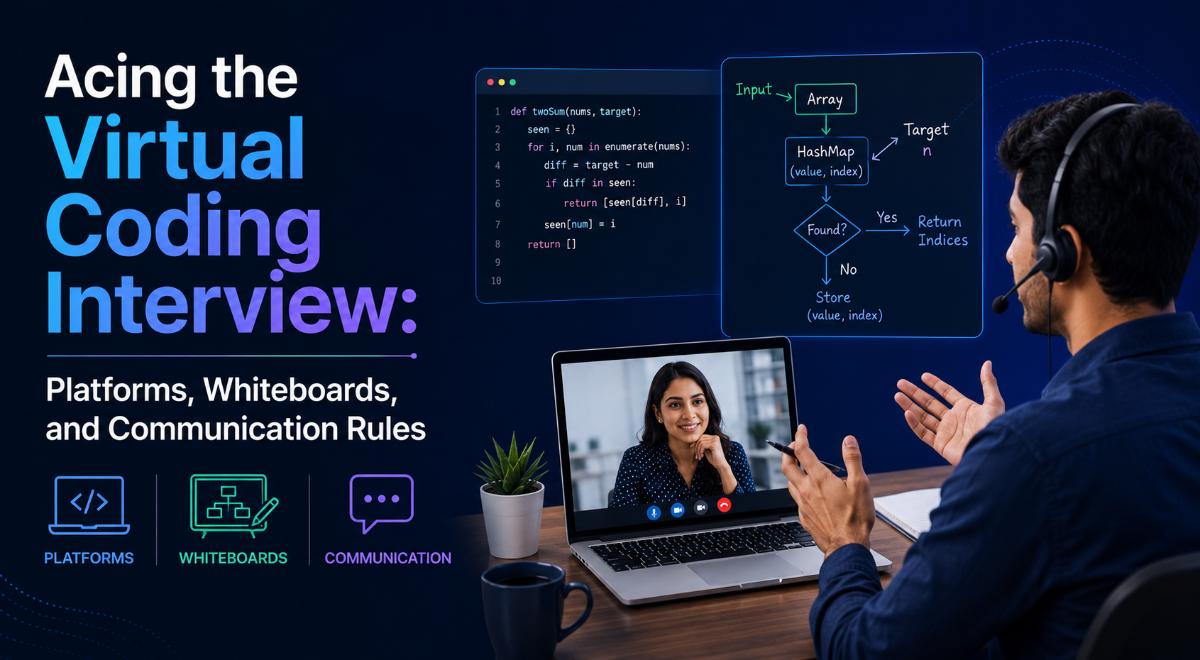
In the modern tech job market, the physical whiteboard interview has been almost entirely replaced by the virtual coding interview. Companies use shared coding environments (like CoderPad, Codility, HackerRank, or Codeshare) paired with video tools (like Zoom or Teams) to test a candidate's software engineering skills in real-time. For many developers, coding live while an interviewer watches is highly stressful, often leading to mistakes that they wouldn't normally make.
To succeed, you must understand that the interviewer is not just looking for a compilable solution. They are evaluating your problem-solving process, how you handle edge cases, and your verbal communication. This guide outlines the key platforms, checklist steps, and communication frameworks to ace your next virtual live coding round.
1. Master the Top Coding Platforms
Before your interview, make sure you are familiar with the tool the company is using. Each has unique features:
- CoderPad / Codeshare: These are collaborative text editors. They do not have auto-complete or full IDE functions. Practice writing clean code without relying on IDE hints. You can compile and run code to see console outputs.
- HackerRank / Codility: Often used for automated tests. You are presented with a description and a set of test cases. Pay close attention to time complexity limits, as inefficient loops will cause tests to time out.
- Excalidraw / Zoom Whiteboard: Used for system design interviews. Practice drawing boxes, arrows, database schemas, and API flows beforehand.
2. The "Think Out Loud" Rule (Most Critical)
The biggest mistake candidates make is falling silent for 10 minutes while writing code. The interviewer cannot read your mind. If you do not talk, they cannot see your logic, and if you take a wrong path, they cannot guide you back.
How to communicate effectively:
- Explain your thought process step-by-step. Say: "First, I'm going to iterate through the array to find the maximum value, and then I will..."
- If you are unsure of the optimal solution, start by describing a brute-force approach first. Say: "The simple way to solve this is using nested loops with O(N²) complexity, but I can optimize this to O(N) by using a HashMap. Let me explain how..."
- If you get stuck, say what you are trying to solve: "I need to prevent index out of bounds here, so I'm thinking about my loop exit condition." Often, the interviewer will drop a subtle hint to help you.
3. The Step-by-Step Execution Plan
When the interviewer pastes the coding question, do not start typing code immediately. Follow this structured process:
- Clarify the requirements: Ask questions about inputs and constraints. Ask: "Can the array contain negative numbers? Can it be empty? Are duplicates possible?"
- Write test cases first: Write 2 or 3 sample input/output examples in comments, including one edge case (like null inputs or empty strings).
- Outline the algorithm: Write down your steps in plain English (pseudocode) before writing actual code.
- Write the code: Keep it clean. Use descriptive variable names (e.g., `userIndex` instead of `i`). Write modular helper functions if necessary.
- Dry run the code manually: Trace through your code using one of your test cases step-by-step to show the interviewer it works before compiling it.
Written by JobPortal Editorial Team
Senior Career Advisor & Recruitment Specialist at JobPortalConnect. With years of experience in HR matching, they review resumes, optimize career pathways, and interview recruiting partners directly.