





Decoding the Indian IT Hierarchy: From Software Engineer to Architect and CTO
The Structure of the Indian IT Workplace
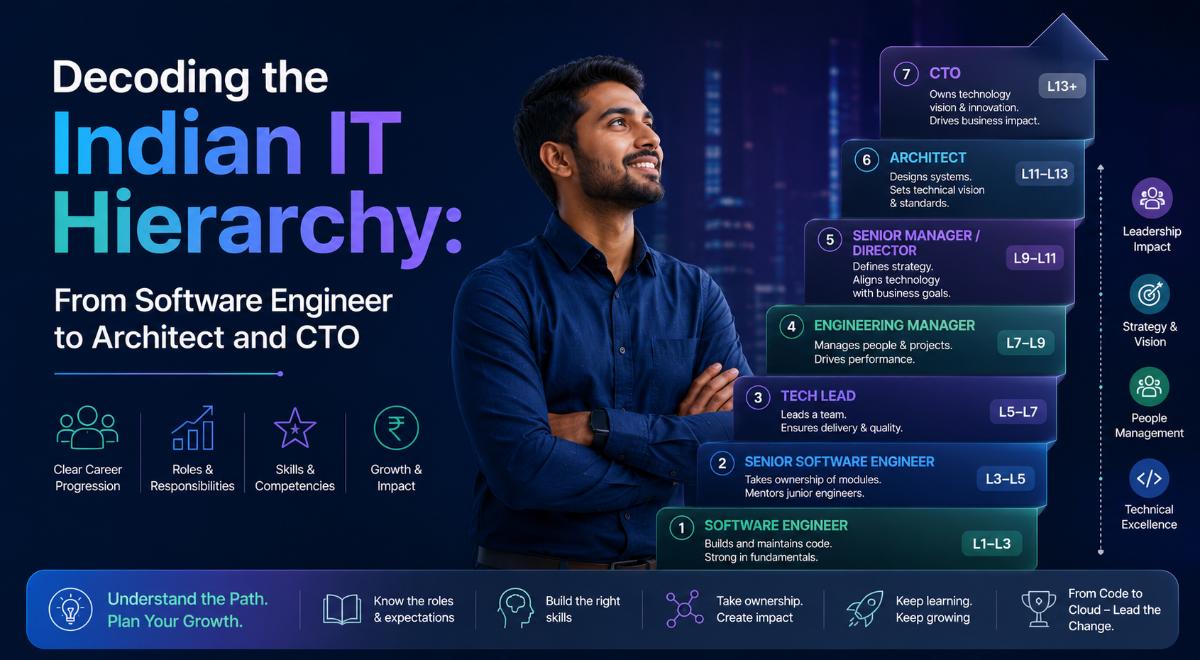
The Indian IT industry is one of the largest employers of engineering talent globally. However, for freshers and mid-level professionals, the career path can often look confusing. With a variety of job titles across service-based giants (like TCS, Infosys, Wipro, and Cognizant) and product-based multinationals (like Microsoft, Amazon, and various tech startups), understanding where you stand on the corporate ladder—and what is needed to reach the next rung—is crucial for long-term career planning.
Climbing the IT hierarchy is no longer just about technical expertise. As you progress, the required skillset shifts dynamically from writing code to system design, project management, customer relations, and executive strategy. This guide breaks down the typical career path in Indian IT and what is expected of you at each stage.
Stage 1: The Entry-Level Roles (0 - 2 Years)
Common titles: Associate Software Engineer (ASE), Graduate Engineer Trainee (GET), Systems Engineer.
This is where your professional journey begins. At this stage, your main goal is learning and execution.
- Primary Responsibilities: Writing basic code, fixing minor bugs, writing unit tests, and understanding the project's codebase. You will typically work under the close supervision of a senior developer or team lead.
- Core Skills Needed: Strong foundation in at least one programming language (Java, C#, JavaScript, Python), understanding basic SQL queries, and familiarity with Git control commands.
- Key Milestone: Learning how to follow coding standards, ask technical questions productively, and write clean, readable code.
Stage 2: The Core Developer (2 - 5 Years)
Common titles: Software Engineer (SE), Senior Systems Engineer, Analyst Programmer.
At this stage, you are expected to work independently. You should be able to take a feature requirement and implement it from start to finish without constant guidance.
- Primary Responsibilities: Designing and implementing features, debugging complex issues, participating in code reviews, and writing technical documentation.
- Core Skills Needed: Mastery of your language and framework (e.g., Spring Boot, React, .NET Core), database design, REST API development, and basic debugging tools.
- Key Milestone: Proving that you can deliver reliable, bug-free features on time and taking ownership of specific modules of the application.
Stage 3: The Tech Lead & Senior Engineer (5 - 9 Years)
Common titles: Senior Software Engineer (SSE), Tech Lead (TL), Associate Consultant.
This is a pivotal stage where you transition from pure execution to mentoring and design. You serve as the link between management and the developer team.
- Primary Responsibilities: Defining code architecture, selecting frameworks, mentoring junior developers, conducting code quality audits, and coordinating with product managers to clarify requirements.
- Core Skills Needed: Advanced system design, code design patterns, cloud infrastructure (AWS, Azure), and soft skills like active listening, mentoring, and delegation.
- Key Milestone: Leading a team to successfully deliver a major project release while maintaining clean, scalable, and secure code architecture.
Stage 4: The Path Specialization (9 - 15 Years)
At this point, your career path splits into two main tracks based on your strengths and interests: the Technical Track and the Management Track.
Track A: The Technical Specialist
Common titles: Technical Architect, Principal Engineer, Solution Architect.
If you love coding and designing systems but dislike administrative management:
- Focus: System scalability, microservices design, security frameworks, database optimization, and setting engineering best practices across the organization.
- Skills: Cloud architecture, Kubernetes, system performance tuning, and evaluating new technology adoptions.
Track B: The Engineering Manager
Common titles: Engineering Manager (EM), Delivery Manager, Project Manager.
If you prefer leading people, project budgeting, and coordination:
- Focus: Resource planning, sprint planning, client communication, career growth plan reviews for developers, and project timeline management.
- Skills: Agile/Scrum methodologies, budgeting, people management, and conflict resolution.
Stage 5: The Executive Leadership (15+ Years)
Common titles: Director of Engineering, VP of Technology, Chief Technology Officer (CTO).
At the top of the hierarchy, your decisions shape the company's business direction.
- Focus: Technology strategies that align with business growth, selecting enterprise-level platforms, managing multimillion-dollar budgets, and building high-performance tech organizations.
- Skills: Executive leadership, business acumen, vendor negotiation, and long-term tech trend forecasting.
Written by JobPortal Editorial Team
Senior Career Advisor & Recruitment Specialist at JobPortalConnect. With years of experience in HR matching, they review resumes, optimize career pathways, and interview recruiting partners directly.