





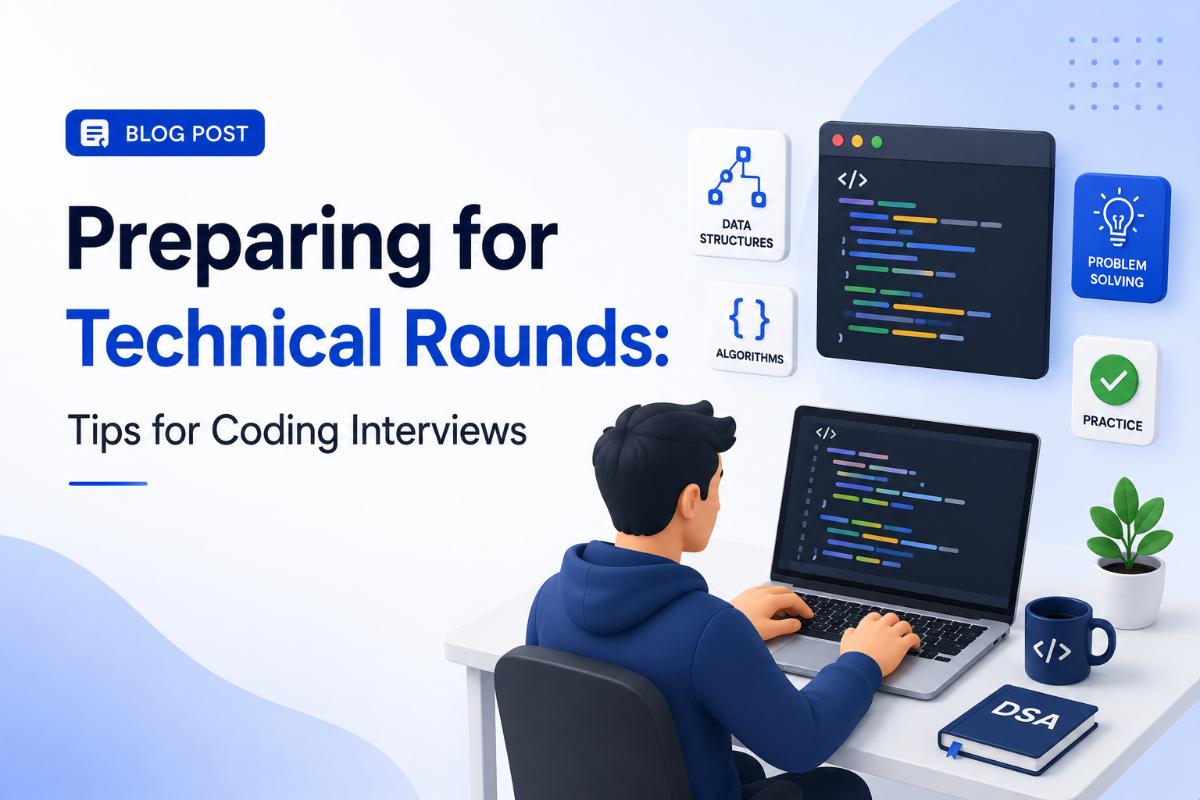
Preparing for Technical Rounds: Tips for Coding Interviews
The Reality of Technical Interviews
Technical coding interviews can be stressful. Sitting in front of a senior engineer and writing code while explaining your thoughts is a challenge. Many developers fail technical rounds not because they cannot code, but because they do not communicate their solution strategy effectively. This guide covers how to structure your coding practice and explain your thought process to ace your next technical round.
1. The "Think Aloud" Technique
The most important rule during a coding interview is: **Never code in silence.** Recruiters care more about *how you think* and solve problems than whether you write a perfect, syntax-error-free script on the first attempt.
- Before typing any code, state the problem in your own words to confirm your understanding.
- Discuss potential edge cases (e.g., empty arrays, null values, negative inputs).
- Explain your proposed solution approach and why you chose it.
- As you type, describe what each block of code does.
2. Focus on Time & Space Complexity
When you present a solution, the interviewer will ask: "What is the time complexity of this code?"
- Be comfortable with **Big O Notation**.
- Explain trade-offs between speed (Time) and memory (Space). For example, explain how using a HashMap can reduce a search time from O(N²) to O(N) by sacrificing a little memory.
- Always present a brute-force approach first, and then explain how you plan to optimize it.
3. Practice Clean Code Habits
Write readable, professional code during the interview:
- Use descriptive variable names (e.g.,
userIdinstead ofx). - Keep functions small and focused on a single responsibility.
- Handle potential null references or index out of bound errors cleanly.
Written by JobPortal Editorial Team
Senior Career Advisor & Recruitment Specialist at JobPortalConnect. With years of experience in HR matching, they review resumes, optimize career pathways, and interview recruiting partners directly.