




Top 15 Front-End Web Developer Interview Questions
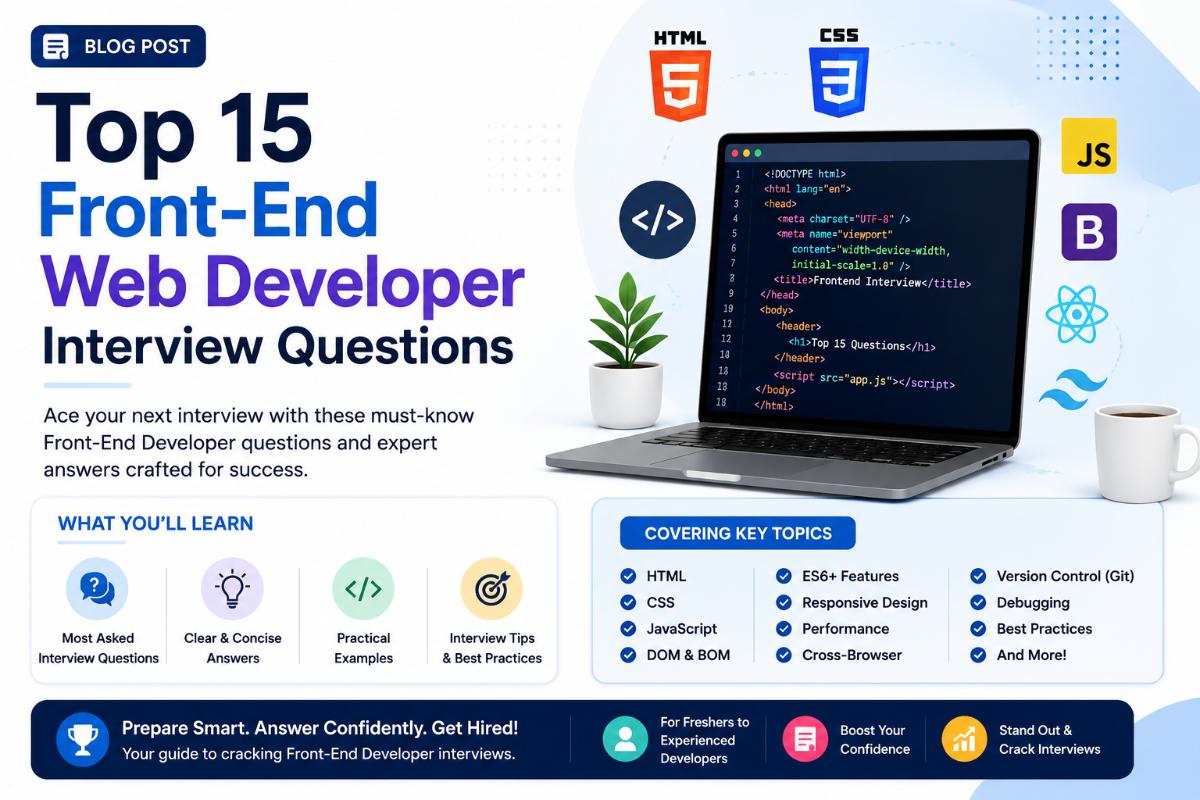
Cracking the Front-End Developer Interview
Front-end web development has evolved rapidly. Today, hiring managers look beyond basic HTML and CSS knowledge. They want developers who understand performance optimization, modern JavaScript frameworks, state management, and semantic SEO practices. This guide compiles the top 15 interview questions that you're likely to encounter in 2026, along with detailed answers.
1. What is the difference between semantic HTML and non-semantic HTML?
Semantic HTML uses elements that clearly describe their meaning to both the browser and the developer (e.g., <header>, <nav>, <main>, <article>, <footer>). Non-semantic HTML elements like <div> and <span> tell us nothing about their content. Semantic HTML is crucial for web accessibility (readers) and search engine optimization (SEO).
2. Explain the CSS Box Model.
The CSS Box Model is a container that wraps every HTML element. It consists of four layers, from the inside out:
- Content: The actual text or image.
- Padding: Clear area around the content, inside the border.
- Border: A border that goes around the padding and content.
- Margin: Clear area outside the border, separating the element from neighbors.
Using box-sizing: border-box; ensures that padding and borders are included in the element's total width and height, making layouts much easier to manage.
3. What are CSS Custom Properties (Variables) and their advantages?
CSS variables allow you to store specific values (like colors or sizes) and reuse them throughout your stylesheet. They are defined using the --variable-name syntax and accessed via var(--variable-name). Unlike SASS variables, CSS variables are dynamic; they can be updated in real-time using JavaScript, making them ideal for theme switching (e.g., Dark Mode).
4. What is the difference between "==" and "===" in JavaScript?
== (loose equality) compares two values for equality after performing type conversion (coercion). For example, 5 == "5" returns true. === (strict equality) compares both the value and the type, meaning no coercion takes place. For example, 5 === "5" returns false. Always prefer === to prevent bugs.
5. What is JavaScript Closure?
A closure is the combination of a function bundled together with references to its surrounding state (the lexical environment). In simpler terms, a closure gives an inner function access to the outer function's scope even after the outer function has finished executing. Closures are commonly used for data privacy and creating factory functions.
6. What are ES6 Arrow Functions and how do they differ from regular functions?
Arrow functions provide a shorter syntax for writing functions (e.g., const add = (a, b) => a + b;). The primary difference is that arrow functions do not have their own this context. They lexically bind this to the enclosing scope, which is extremely useful when writing callback functions inside React components or asynchronous operations.
7. Explain the concept of DOM Event Delegation.
Event delegation is a technique where you attach a single event listener to a parent element rather than attaching individual listeners to multiple child elements. It works due to event bubbling, where an event triggered on a child bubbles up to its parents. This improves memory efficiency, especially when dealing with lists where children are added or removed dynamically.
8. What is the difference between localStorage, sessionStorage, and Cookies?
These are browser storage options:
- localStorage: Stores data with no expiration date. Data persists even after the browser is closed. Capacity: ~5MB.
- sessionStorage: Stores data only for the duration of the page session. Data is cleared when the tab is closed. Capacity: ~5MB.
- Cookies: Stores data that can be sent to the server with every HTTP request. Used for session management. Capacity: ~4KB.
9. What is a Single Page Application (SPA) and how does client-side routing work?
An SPA is a web application that loads a single HTML page and dynamically updates it as the user interacts with the app, without reloading the full page. Client-side routing (e.g., React Router) manages URLs in the browser via the HTML5 History API, loading components dynamically without requesting new HTML documents from the server.
10. What is Virtual DOM in React?
The Virtual DOM is a lightweight, in-memory representation of the real DOM. When a component's state changes, React updates the Virtual DOM first. It then compares the new Virtual DOM with the previous one (a process called Diffing) and updates only the changed parts of the real DOM (called Reconciliation). This avoids expensive full-page reflows and improves UI speed.
11. How do you optimize web page loading performance?
Key optimization strategies include:
- Minifying and bundling CSS and JS.
- Using lazy-loading for images and code-splitting/lazy-loading for JS routes.
- Compressing images and converting them to modern formats (WebP).
- Leveraging browser caching and Content Delivery Networks (CDNs).
- Deferring non-critical JS using `defer` or `async` tags.
Written by JobPortal Editorial Team
Senior Career Advisor & Recruitment Specialist at JobPortalConnect. With years of experience in HR matching, they review resumes, optimize career pathways, and interview recruiting partners directly.