





The Ultimate Pharmaceutical QC Written Exam Question Bank (With Answers)
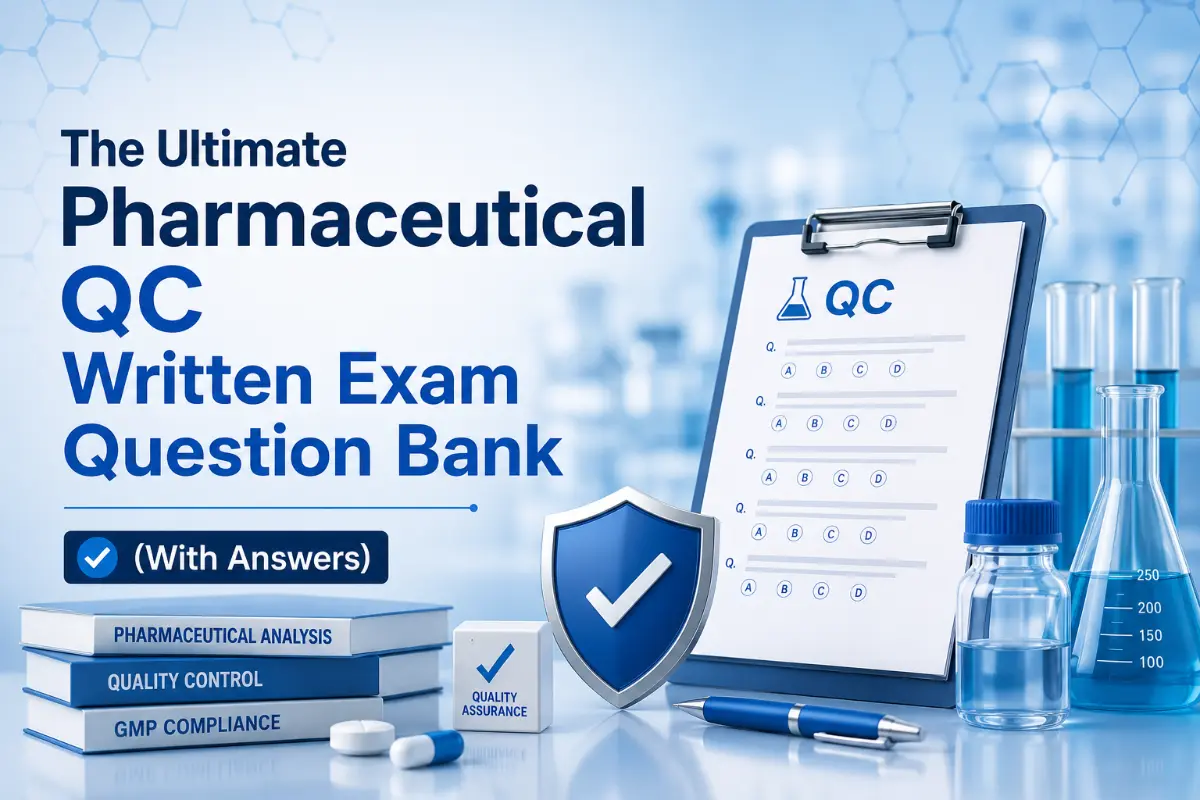
Securing an entry-level position as a Quality Control (QC) Officer in a pharmaceutical manufacturing facility requires passing a rigorous technical written exam. To help you prepare, we have compiled the ultimate question bank consisting of 62 core questions across general QC principles, instrumentation (HPLC, GC, spectroscopy), GMP, validations, pharmacopoeias, and calculations—complete with professional, regulatory-compliant answers.
Exam Guide Sections
- 🔬 Part 1: General Quality Control (GQC)
- 🧪 Part 2: Instrumental Analysis & Chromatography
- 📋 Part 3: GMP, Documentation, Compliance
- ⚙️ Part 4: Calibration & Validation
- 💊 Part 5: Formulations & Biology Testing
- 📊 Part 6: Calculations & Laboratory Prep
- 🛡️ Part 7: Pharmacopoeias, Guidelines & Impurities
- 🏷️ Part 8: Essential Abbreviations & Terms
🔬 Part 1: General Quality Control (GQC)
1. What are the responsibilities of a QC Officer in a pharmaceutical company?
Answer: A QC Officer is responsible for sampling, inspecting, and testing raw materials, packaging materials, in-process blends, and finished drug batches to verify they meet specifications. They are also responsible for performing standardizations, maintaining instrument calibrations, registering logbooks, handling deviations, and preparing Certificate of Analysis (CoA) reports.
2. What is density? Write its unit. What is specific gravity? Differentiate between the two.
Answer: Density: The mass of a substance per unit volume. Unit: $g/cm^3$ or $g/mL$.
Specific Gravity: The ratio of the density of a substance to the density of a reference substance (usually water at 4°C). It is dimensionless (no units).
Difference: Density is an absolute measurement containing physical units, whereas specific gravity is a relative comparison and dimensionless.
3. Define viscosity and mention its unit.
Answer: Viscosity is the measure of a fluid's resistance to gradual deformation by shear or tensile stress (its internal thickness/friction). Unit: Poise (P), Centipoise (cP), or Pascal-seconds ($Pa \cdot s$).
4. What is pH? Explain acidic, basic, and neutral ranges.
Answer: pH (potential of Hydrogen) is the negative logarithm of the hydrogen ion concentration ($pH = -\log[H^+]$). Acidic range: $< 7.0$; Neutral: $= 7.0$; Basic (alkaline) range: $> 7.0$.
5. Define molarity, molality, and normality.
Answer: Molarity (M): Number of moles of solute dissolved in 1 liter of solution ($mol/L$).
Molality (m): Number of moles of solute per kilogram of solvent ($mol/kg$).
Normality (N): Number of gram equivalents of solute dissolved in 1 liter of solution ($eq/L$).
6. What is ppm? Convert ppm to mg/L.
Answer: ppm stands for "parts per million", representing one part of solute per one million parts of total solution. In aqueous solution, $1\text{ ppm} = 1\text{ mg/L}$ because 1 liter of water weighs approximately $1,000,000\text{ mg}$.
7. What is a buffer solution? Give examples.
Answer: A buffer solution resists changes in pH when small quantities of an acid or an alkali are added to it. Examples: Phosphate buffer, Acetate buffer, Citrate buffer.
8. What are hygroscopic substances? What is corrosion? Give examples.
Answer: Hygroscopic: Substances that readily absorb moisture/water from the surrounding atmosphere without dissolving. Example: Silica gel, anhydrous calcium chloride.
Corrosion: The gradual destruction of materials (usually metals) by chemical or electrochemical reaction with their environment. Example: Rusting of iron.
9. What is conductivity? Mention its unit.
Answer: Conductivity is a measure of a material's ability to conduct an electric current. Unit: Siemens per meter ($S/m$) or microSiemens per centimeter ($\mu S/cm$).
10. What is titration? What is acid-base titration? Give examples.
Answer: Titration: A laboratory method of quantitative chemical analysis used to determine the concentration of an identified analyte by reacting it with a standard reagent (titrant) of known concentration.
Acid-Base Titration: A titration based on neutralization reaction between an acid and a base. Example: Titration of Hydrochloric acid ($HCl$) with Sodium hydroxide ($NaOH$).
11. Difference between endpoint and equivalence point?
Answer: The **Equivalence Point** is the theoretical point where the moles of titrant added are chemically equivalent to the moles of analyte in the sample. The **Endpoint** is the physical point where the reaction completed indicator changes color, signifying the operator to stop titrating.
12. What is Complexometric titration?
Answer: A titration based on the formation of a stable, soluble complex between metal ions and a chelating agent (usually EDTA) in solution.
13. EDTA is used in which type of titration?
Answer: EDTA (Ethylenediaminetetraacetic acid) is used in **Complexometric Titrations** to determine the hardness of water or quantitative concentration of metal ions (like $Ca^{2+}$, $Mg^{2+}$, $Zn^{2+}$).
14. What is Karl Fischer titration used for?
Answer: Karl Fischer (KF) titration is used for the highly specific determination of trace quantities of water (moisture content) in active pharmaceutical ingredients, excipients, and final products.
15. What is a primary standard? What is a secondary standard?
Answer: Primary Standard: A highly pure, stable chemical compound of known composition used to standardize volumetric solutions. Example: Sodium carbonate, Potassium hydrogen phthalate (KHP).
Secondary Standard: A standard solution prepared and standardized against a primary standard for routine laboratory analysis. Example: Sodium hydroxide ($NaOH$).
16. What is an indicator? Give examples.
Answer: An indicator is a chemical substance that undergoes a visible physical change (usually color change) at or near the equivalence point of a titration. Examples: Phenolphthalein (acid-base), Methyl orange (acid-base), Eriochrome Black T (complexometric).
17. What is standardization of a solution?
Answer: The process of determining the exact concentration (normality or molarity) of a prepared solution by reacting it against a calculated mass of a primary standard or a known volume of another standardized solution.
🧪 Part 2: Instrumental Analysis & Chromatography
18. What is HPLC? Mention its major components. What is GC? Where is it used?
Answer: HPLC (High-Performance Liquid Chromatography): A separation technique using liquid mobile phase to drive sample mixtures through a stationary phase column under high pressure. Components: Solvent Reservoir, Pump, Injector, Column, Detector, Chromatographic Integrator.
GC (Gas Chromatography): A separation technique using an inert gas carrier to separate volatile mixtures in a temperature-controlled column. Used for analyzing volatile organic solvents, residual solvents (OVI), and essential oils.
19. What is TLC? Define Rf value.
Answer: TLC (Thin Layer Chromatography): A planar separation technique where sample analytes migrate along a thin layer of stationary phase coated on a glass or plastic plate.
Rf (Retention Factor): The ratio of distance traveled by the solute spot to the distance traveled by the mobile phase solvent front: $Rf = \text{Distance spot} / \text{Distance solvent}$. It is always $< 1.0$.
20. What is UV spectroscopy? What is IR spectroscopy?
Answer: UV-Vis Spectroscopy: Measures electronic transitions (absorption of light in 200–800 nm range) by molecules containing conjugated double bonds. Used for quantitative assay calculations.
IR (Infrared) Spectroscopy: Measures molecular vibrational levels (4000-400 $cm^{-1}$) following absorption of IR radiation. Used primarily for qualitative structural identification of drug compounds.
21. State Beer-Lambert Law.
Answer: The absorbance of a monochromatic light beam passing through a uniform solution is directly proportional to the concentration of the solute ($c$) and the path length of the medium ($b$): $A = a \cdot b \cdot c$ (where $A$ is absorbance and $a$ is molar absorptivity).
22. What is the fingerprint region in IR spectroscopy?
Answer: The region of the infrared spectrum ranging from 1500 to 500 $cm^{-1}$. This region contains highly complex, unique vibrational absorption bands representing single-bond bending/stretching patterns specific to a particular molecule, acting like a structural fingerprint.
23. Differentiate between UV and IR spectroscopy.
Answer: UV spectroscopy operates in the 200-800 nm range, measures electronic transitions, and is used for quantitative concentration measurements. IR spectroscopy operates in the 2.5-25 $\mu m$ (or 4000-400 $cm^{-1}$) range, measures vibrational and rotational transitions, and is used for qualitative chemical identification.
24. What is a system suitability test in HPLC?
Answer: System Suitability Test (SST) is an automated injection verification run performed prior to sample analysis to confirm the HPLC system, column, detector, and preparation are functioning within acceptable performance limits. Key parameters evaluated include Peak Area RSD, Theoretical Plates, Tailing Factor, and Resolution.
25. What is chromatography?
Answer: Chromatography is a physical separation method in which the components of a mixture are distributed between two phases: a stationary phase (which stays fixed) and a mobile phase (which moves in a definite direction).
26. Differentiate between normal-phase and reverse-phase chromatography.
Answer: In **Normal-Phase Chromatography**, the stationary phase is polar (e.g. silica gel) and the mobile phase is non-polar (e.g. hexane). In **Reverse-Phase Chromatography**, the stationary phase is non-polar (e.g. C18 silica column) and the mobile phase is polar (e.g. water/acetonitrile mixtures).
27. What is a stationary phase? Mobile phase? Retention time?
Answer: Stationary Phase: The solid or liquid support column packing substance that remains fixed in place.
Mobile Phase: The liquid or gas fluid that carries the analyte mixture through the stationary phase.
Retention Time (Rt): The time elapsed between sample injection and the point of peak maximum detection of an analyte.
28. What is resolution in chromatography?
Answer: Resolution ($Rs$) is the quantitative measure of the degree of separation between two adjacent elution peaks in a chromatogram. Ideally, $Rs \geq 1.5$ is required for baseline separation.
29. What causes peak tailing in HPLC?
Answer: Peak tailing (asymmetry $> 1.2$) is commonly caused by column aging, silanol group interactions with basic analytes, column overloading, air bubbles in the flow path, or incorrect mobile phase pH.
30. What is column efficiency?
Answer: Column efficiency is a measure of the column's ability to separate mixtures into narrow, well-resolved bands. It is mathematically measured as the number of theoretical plates ($N$)—higher values indicate higher efficiency.
31. What is theoretical plate number?
Answer: An abstract concept representing an individual imaginary zone where partitioning of the analyte between stationary and mobile phase occurs. More theoretical plates ($N$) result in narrower peaks and better resolution.
32. What is peak broadening?
Answer: The dispersion of analyte molecules as they migrate through a chromatographic column, resulting in wider chromatographic peaks. It is described by the Van Deemter equation factoring Eddy diffusion, longitudinal diffusion, and resistance to mass transfer.
📋 Part 3: GMP, Documentation, Compliance
33. What is GMP? GLP? SOP?
Answer: GMP (Good Manufacturing Practice): Regulations enforcing minimum systems standards to ensure drugs are consistently manufactured and verified for quality.
GLP (Good Laboratory Practice): A quality system governing the organizational processes and environmental conditions for non-clinical health and safety studies.
SOP (Standard Operating Procedure): Written, step-by-step instructions designed to ensure consistent execution of routine laboratory or plant activities.
34. What is deviation? CAPA? OOS? OOT? Change control?
Answer: Deviation: Any unplanned departure from an approved SOP, specification, or process standard.
CAPA (Corrective and Preventive Action): System designed to eliminate root causes of non-conformities and prevent their recurrence.
OOS (Out of Specification): Test result that falls outside established regulatory specification limits.
OOT (Out of Trend): Test result that is within specifications but shows an atypical statistical drift over time.
Change Control: Formal process of evaluating and authorizing any modification to plant, process, software, or raw material.
35. What is data integrity?
Answer: Data Integrity is the maintenance and assurance of data accuracy, completeness, consistency, and security across its entire lifecycle, protecting it from unauthorized modification or deletion.
36. Explain ALCOA+ principles.
Answer: ALCOA+ represents the foundational requirements of data integrity: Attributable (who generated it), Legible (easy to read), Contemporaneous (recorded in real-time), Original (original print/data), Accurate (truthful). The "+" represents: Complete, Consistent, Enduring, and Available.
⚙️ Part 4: Calibration & Validation
37. What is validation? Method validation? Calibration? Qualification? IQ, OQ, PQ?
Answer: Validation: The documented evidence that a process, software, or equipment consistently produces the desired quality results.
Method Validation: Proving that an analytical method is suitable for its testing purposes.
Calibration: Verifying an instrument's measurements against a traceable reference standard.
Qualification: Verifying equipment/facility meets requirements. Divided into **IQ** (Installation Qualification), **OQ** (Operational Qualification), and **PQ** (Performance Qualification).
38. What are the parameters of method validation?
Answer: According to ICH Q2(R1) guidelines, the parameters include Accuracy, Precision (Repeatability, Intermediate Precision, Reproducibility), Specificity, Linearity, Range, Detection Limit (LOD), Quantitation Limit (LOQ), and Robustness.
39. What is accuracy, precision, linearity, robustness, ruggedness, and stability study?
Answer: Accuracy: Close agreement to the true value.
Precision: Closeness of values in replicate measurements.
Linearity: Ability to produce results proportional to concentration.
Robustness: Resistance to small, deliberate changes in method conditions.
Ruggedness (Intermediate Precision): Reproducibility under different analysts, days, or equipment.
Stability Study: Testing drugs over time to evaluate how their quality changes under temperature/humidity.
40. What are ICH stability zones? Define accelerated stability testing.
Answer: ICH Stability Zones: Four global zones based on climate: Zone I (Temperate), Zone II (Subtropical), Zone III (Hot/Dry), Zone IVa (Hot/Humid), Zone IVb (Hot/Very Humid).
Accelerated Stability Testing: Testing a drug under extreme stress conditions (typically 40°C ± 2°C / 75% RH ± 5% RH for 6 months) to predict long-term shelf life and degradation pathways.
💊 Part 5: Formulations & Biology Testing
41. What is a dissolution test? Differentiate between dissolution and disintegration.
Answer: Dissolution Test: Measures the rate and extent at which active pharmaceutical ingredients dissolve into a liquid medium under standard conditions.
Disintegration: The physical breakdown of a solid dosage form (tablet/capsule) into smaller granules or fragments.
Difference: Disintegration is a mechanical breakup (no chemical dissolving required), while dissolution is the chemical dissolution of the API into solution.
42. What is sink condition?
Answer: A dissolution environment where the volume of dissolution medium is at least 3 to 10 times the saturation volume of the drug API, ensuring that the concentration of dissolved drug does not inhibit further dissolution.
43. What is shelf life? What is a retest period?
Answer: Shelf Life: The time period during which a drug product is expected to remain fit for use under label storage conditions.
Retest Period: The period during which an Active Pharmaceutical Ingredient (API) can be stored and used, provided it is re-tested immediately before usage to confirm compliance.
44. What is sterility?
Answer: Sterility is the complete absence of all living microorganisms (including vegetative bacteria, viruses, fungi, and spores). It is an absolute, non-relative state.
45. What is an endotoxin? What is microbial limit test?
Answer: Endotoxin: Toxic lipopolysaccharides located in the outer membrane of Gram-negative bacteria, which can cause severe fever and shock in patients.
Microbial Limit Test (MLT): Quality tests performed on non-sterile products to estimate the total count of viable aerobic microorganisms and identify specific pathogens.
46. What is a preservative efficacy test?
Answer: Preservative Efficacy Test (PET) is a test to verify that the antimicrobial preservatives added to a multi-dose formulation effectively inhibit the growth of microorganisms introduced accidentally during consumer use.
47. What is an aseptic process? What is MSDS?
Answer: Aseptic Process: Handling sterile products in an environment controlled to prevent microbial contamination.
MSDS (Material Safety Data Sheet): A document detailing safety information, handling procedures, hazard warnings, and emergency measures for chemical substances.
48. What are PPEs used in laboratories?
Answer: Personal Protective Equipment (PPE) used in pharmaceutical laboratories includes Lab Coats, Safety Glasses/Goggles, Nitrile Gloves, Face Shields, and Masks (N95 or particulate respirators).
📊 Part 6: Calculations & Laboratory Prep
49. How will you prepare 0.1N NaOH solution?
Answer: NaOH has an equivalent weight of 40 g/eq. To prepare 1 liter of 1N NaOH, you dissolve 40 g. For 0.1N NaOH, dissolve 4.0 grams of NaOH pellets in about 500 mL of distilled water, mix to dissolve, and dilute the final volume to 1000 mL in a volumetric flask. Finally, standardize it against potassium hydrogen phthalate (KHP).
50. How do you calculate assay percentage?
Answer: Assay % is calculated by comparing sample response to standard response:
$\text{Assay \%} = (\text{Sample Area} / \text{Standard Area}) \times (\text{Standard Weight} / \text{Sample Weight}) \times (\text{Purity of Standard}) \times 100$.
51. What is a dilution factor?
Answer: Dilution factor is the ratio of the final volume of a diluted solution to the initial aliquot volume taken: $\text{Dilution Factor} = \text{Final Volume} / \text{Aliquot Volume}$. For multi-step dilutions, individual factors are multiplied.
52. Convert 500 ppm into mg/L.
Answer: Since 1 ppm in aqueous solution equals 1 mg/L, **500 ppm is equal to 500 mg/L**.
53. Calculate molarity from given data.
Answer: Molarity ($M$) is calculated as: $M = \text{Weight of solute (g)} / (\text{Molecular weight} \times \text{Volume of solution in liters})$.
54. Calculate percentage purity from assay data.
Answer: $\text{\% Purity} = (\text{Experimental concentration} / \text{Theoretical concentration}) \times 100$. Or by titration: $\text{\% Purity} = (\text{Volume of titrant consumed (mL)} \times \text{Normality of titrant} \times \text{Equivalent weight}) / \text{Weight of sample (mg)} \times 100$.
55. What is factor calculation in titration?
Answer: The factor is the amount of analyte in milligrams that is chemically equivalent to 1 mL of a standard volumetric solution (titrant) of exact normality (e.g. $1\text{ mL of } 0.1\text{N NaOH} = 6.005\text{ mg of glacial acetic acid}$).
🛡️ Part 7: Pharmacopoeias, Guidelines & Impurities
56. What is a pharmacopoeia?
Answer: A pharmacopoeia is an officially published directory containing standards, specifications, test methods, and monographs for active pharmaceutical ingredients and excipients used in a region.
57. Differentiate between USP and BP.
Answer: **USP** (United States Pharmacopeia) publishes regulatory quality standards for the United States, whereas **BP** (British Pharmacopoeia) publishes standards for the United Kingdom. They differ in test conditions, dissolution limits, and chemical specification values for monographs.
58. What is an ICH guideline?
Answer: The International Council for Harmonisation (ICH) guidelines are international standards harmonizing technical requirements for registration of pharmaceuticals. They are divided into Quality (Q), Safety (S), Efficacy (E), and Multidisciplinary (M) categories.
59. What is a nitrosamine impurity? What is NDSRI?
Answer: Nitrosamine Impurity: Genotoxic chemical compounds containing a nitroso functional group linked to an amine (e.g. NDMA). They are classified as probable human carcinogens.
NDSRI (Nitrosamine Drug Substance-Related Impurities): Complex, drug-specific nitrosamine impurities formed by reaction of secondary or tertiary amines in the active drug substance with nitrites during manufacturing or storage.
60. What is a genotoxic impurity?
Answer: A genotoxic impurity is a chemical compound that can directly damage cellular DNA, causing mutations or potentially triggering cancer, even at very low exposure levels.
61. What is an acceptable intake (AI) limit?
Answer: Acceptable Intake (AI) is the maximum daily exposure limit of a mutagenic impurity (like nitrosamines) that is considered to represent a negligible risk of cancer (e.g., less than 1 in 100,000 lifetime risk).
🏷️ Part 8: Essential Abbreviations & Terms
62. Define the following abbreviations:
- HPLC: High-Performance Liquid Chromatography
- GC: Gas Chromatography
- AAS: Atomic Absorption Spectroscopy
- TLC: Thin Layer Chromatography
- UV: Ultraviolet
- IR: Infrared
- GMP: Good Manufacturing Practice
- GLP: Good Laboratory Practice
- SOP: Standard Operating Procedure
- CAPA: Corrective and Preventive Action
- OOS: Out of Specification
- OOT: Out of Trend
- LOD: Limit of Detection (or Loss on Drying)
- API: Active Pharmaceutical Ingredient
- KFT: Karl Fischer Titration
- MSDS: Material Safety Data Sheet
- FIFO: First In, First Out
- FEFO: First Expired, First Out
- IQ/OQ/PQ: Installation/Operational/Performance Qualification
Written by Lead QC Trainer & Senior Analyst
Senior Career Advisor & Recruitment Specialist at JobPortalConnect. With years of experience in HR matching, they review resumes, optimize career pathways, and interview recruiting partners directly.